Agentic AI has the potential to change commercial insurance underwriting by allowing artificial intelligence to do more than answer questions or summarize documents. AI agents can work toward defined objectives, gather information, use approved tools, evaluate conditions, and help move underwriting workflows forward.
But giving AI more autonomy introduces a fundamental challenge.
An AI system that can act needs to understand the context behind the information it is using.
Commercial P&C underwriting is not simply a document-processing problem. Underwriters make decisions based on relationships between businesses, locations, exposures, classifications, losses, coverages, limits, appetite rules, historical information, and external risk signals.
A general-purpose AI model may be highly capable at reading language while still lacking the specialized commercial insurance knowledge required to interpret those relationships reliably.
This is why insurance-specific risk context is becoming increasingly important as carriers and MGAs explore generative AI, AI agents, and more autonomous underwriting workflows.
The question for underwriting leaders is no longer simply:
Which AI model should we use?
A more important question is:
What information and insurance context is that model grounded in when it supports an underwriting decision?
What Is Insurance-Specific Risk Context?
Insurance-specific risk context is the structured information that helps an AI system understand what commercial insurance data means and how different pieces of information relate to one another.
A commercial submission might contain:
- Named insured information
- Supplemental risk information
Simply extracting these values does not necessarily create underwriting intelligence.
The system also needs to understand the relationships between them.
For example, an address might represent:
Those distinctions can materially affect the underwriting analysis.
Similarly, a loss record only becomes useful when the system understands which insured, location, exposure, and policy period it relates to.
Insurance-specific context gives AI the structure required to interpret those relationships.
Why General-Purpose AI Is Not Enough for Commercial Underwriting
General-purpose large language models are trained to understand and generate language across an enormous range of subjects.
That makes them powerful tools for:
- Conversational interfaces
However, fluency should not be confused with underwriting expertise.
Commercial underwriting contains specialized terminology, classifications, data structures, and relationships that may not be obvious from the text alone.
Consider a submission describing a business as:
Commercial painting contractor.
A general-purpose AI model may understand what painting is.
An underwriting system may need to understand considerably more:
- Does the business perform interior or exterior work?
- Does it perform industrial painting?
- Does it work on bridges or infrastructure?
- Are employees using scaffolding?
- Does it subcontract work?
- Which classification is appropriate?
- Which exposures matter for the requested coverage?
These questions require insurance context.
The model needs more than a dictionary definition of the business.
It needs to understand how that business description connects to commercial P&C risk evaluation.
Convr’s current Risk Context Engine positioning reflects this distinction. The company describes its RCE as a commercial P&C-specific knowledge graph and semantic ontology designed to ground AI underwriting in structured insurance context rather than relying solely on general-purpose model inference. (convr.com)
Agentic AI Raises the Importance of Context
The need for contextual grounding becomes more important as AI takes on a more active role.
Consider two uses of AI.
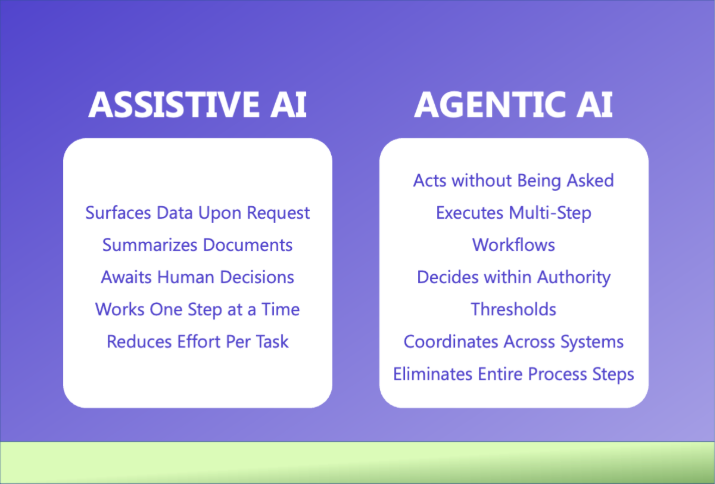
AI Assistant
An underwriter asks:
Summarize the information in this submission.
The AI produces a summary.
The underwriter reviews it and decides what to do next.
AI Agent
The agent is given an objective:
Evaluate whether this submission fits appetite and determine the appropriate next workflow step.
The AI may need to:
- Interpret the submission.
- Identify the business.
- Determine relevant exposures.
- Gather additional information.
- Compare the risk against underwriting criteria.
- Identify missing data.
- Determine whether referral is required.
- Route the account.
The second scenario carries more responsibility.
The AI is not merely producing text.
It is using information to influence what happens next.
If the underlying context is wrong, the workflow decision can also be wrong.
Agentic AI Needs Grounding, Not Just Intelligence
Grounding connects an AI system to trusted information that can support its responses and actions.
For underwriting, grounding may include:
- Original submission documents
- Structured risk information
- Internal underwriting data
- Historical account information
- Classification structures
- Insurance-specific knowledge models
Without grounding, the AI may rely too heavily on general model knowledge or inference.
That creates a problem because underwriting decisions frequently depend on organization-specific information.
An AI agent should not invent a carrier’s appetite.
It should use the actual appetite criteria it has been authorized to access.
It should not guess which exposure applies to a particular location.
It should use structured information that connects the location with the relevant risk.
It should not assume a requested limit falls within an underwriter’s authority.
It should evaluate the applicable authority rules.
Grounding turns an AI model from a general source of language intelligence into a tool capable of operating within a specific underwriting environment.
What Is a Knowledge Graph in Commercial Insurance?
A knowledge graph represents information as connected entities and relationships.
Instead of storing every piece of information as an isolated field, a graph can show how information relates.
A simplified commercial risk might contain relationships such as:
Named Insured
↓
Operates
↓
Business Activity
↓
At
↓
Location
↓
Associated With
↓
Exposure
Losses, policies, classifications, and other information can also be connected to the appropriate entities.
This structure is useful for AI because commercial underwriting depends heavily on relationships.
An underwriter does not simply ask:
What addresses appear in the submission?
They need to know:
Which locations represent insured exposures?
They do not simply ask:
What losses exist?
They need to understand:
Which operations or exposures generated those losses?
A knowledge graph can help preserve that context.
Convr currently positions its Risk Context Engine around this architecture, combining a commercial P&C knowledge graph, ontology, schema, and semantic layer to create a normalized view of risk information used across its underwriting capabilities. (convr.com)
What Is an Insurance Ontology?
An ontology defines concepts and relationships within a particular domain.
For commercial insurance, that domain may include concepts such as:
The ontology helps the system understand what those concepts represent and how they relate.
This becomes particularly useful when different data sources describe the same thing differently.
For example, one source might use:
Annual sales
while another uses:
Annual revenue
The system needs to determine whether those fields represent the same concept within the underwriting context.
Similarly, multiple classification systems may describe a business using different codes or terminology.
A domain-specific ontology can help normalize those differences into a more consistent representation.
Semantic Understanding Helps Connect Fragmented Submission Data
Commercial insurance data rarely arrives through one clean database.
A submission may include:
- Supplemental applications
The same risk may be represented differently across those sources.
A semantic layer helps connect information based on its meaning rather than relying only on identical field names.
This matters because an AI agent may need to evaluate information from several sources before determining what should happen next.
If the data remains fragmented, the AI risks treating related information as separate facts or failing to identify important relationships.
Convr’s underwriting architecture unifies structured and unstructured submission data into a normalized commercial insurance model, which then supports AI, analytics, and underwriting workflows. (convr.com)
Risk Context Can Help Detect Conflicting Information
Grounding is not only about finding information.
It can also help identify when information disagrees.
Suppose a submission contains:
Application revenue: $15 million
Financial statement revenue: $22 million
A simple extraction system might successfully extract both values.
But the underwriting problem is not extraction.
The problem is determining that there is a discrepancy that may need investigation.
The same issue can occur when:
- Business descriptions differ
- Named insureds do not match
- Locations appear inconsistently
- Employee counts vary between sources
An AI system with stronger contextual understanding can surface these conflicts rather than simply presenting multiple values.
That allows the workflow to pause or escalate when information needs human review.
Traceability Matters as AI Becomes More Autonomous
If an AI system only generates an internal summary, an underwriter can independently verify the information.
If the system begins influencing triage, referrals, appetite decisions, or workflow routing, traceability becomes much more important.
The user should be able to determine:
- Where the information came from
- Which source contained it
- Which data point influenced the action
- Why the system reached its conclusion
For example, an AI agent might state:
Referral required because the requested limit exceeds configured authority.
The underwriting team should be able to inspect:
- The applicable authority threshold
That is very different from receiving an unexplained recommendation from a black-box model.
Convr’s RCE and MCP positioning emphasizes this concept by making underwriting context available to AI agents while preserving source traceability for the information returned. (convr.com)
Explainability and Traceability Are Not the Same Thing
These concepts are related but distinct.
Explainability
Explains why the system reached a conclusion.
For example:
This risk requires additional review because the exposure falls outside standard appetite criteria.
Traceability
Shows the information that supports that conclusion.
For example:
- Original business description
An AI system may produce a convincing explanation without having strong traceability.
For underwriting organizations, both matter.
The conclusion should make sense, and users should be able to inspect the evidence behind it.
Insurance-Specific Context Can Support More Consistent Decisions
Commercial carriers often have large underwriting teams operating across:
Two underwriters can interpret the same information differently.
Human judgment is an important part of underwriting, but inconsistency in routine data interpretation or guideline application can create unnecessary variability.
Insurance-specific AI can help create a more consistent foundation.
For example, the system can help ensure that:
- The same risk data is interpreted consistently
- Classifications are evaluated against the same framework
- Relevant information is surfaced systematically
- Mandatory referral conditions are checked
- Source information is preserved
The goal is not to eliminate underwriting judgment.
It is to give underwriters a more consistent information layer on which to apply that judgment.
The Underwriter Still Owns the Decision
A stronger contextual foundation does not mean every underwriting decision should become autonomous.
Commercial risks can involve nuance that is difficult to reduce to a universal set of rules.
An experienced underwriter may consider:
Insurance-specific AI can organize the evidence and automate repeatable checks.
The underwriter can then focus on interpreting what the evidence means.
This represents an important principle for agentic underwriting.
The more effectively technology manages context, data gathering, and repeatable workflow decisions, the more attention human underwriters can give to the areas where professional judgment creates the greatest value.
AI Grounding Is Becoming an Underwriting Infrastructure Question
As insurers evaluate AI, attention naturally goes to the models themselves.
Which model is most accurate?
Which model is fastest?
Which model can handle the largest documents?
Those questions matter.
But commercial underwriting AI also depends on what surrounds the model.
Underwriting leaders increasingly need to consider whether their AI environment can:
- Understand insurance concepts
- Preserve relationships between risk information
- Normalize fragmented submission data
- Connect to approved sources
- Apply carrier-specific rules
- Trace information to its origin
- Support controlled workflow actions
Without those capabilities, increasing AI autonomy may simply increase the speed at which uncertain information moves through the underwriting process.
With the right risk context, agentic AI has the potential to become something much more valuable: a governed decision-support layer that understands the commercial insurance environment in which it is operating.
What Insurance-Specific Context Changes in Practice
Insurance-specific context changes what AI can do with underwriting information.
A general model may be able to summarize a submission. A context-aware underwriting system can connect that information to the concepts, rules, and relationships that matter for the risk.
That can improve several parts of the workflow.
Submission Triage
The system can identify missing information, evaluate whether a submission appears to fit appetite, and determine whether it should proceed, stop, or be escalated.
Risk Enrichment
External information can be connected to the correct insured, location, operation, or exposure rather than added as disconnected data.
Guideline Application
Carrier-specific rules can be evaluated against structured risk information instead of relying on a model to infer what the organization considers acceptable.
Referral Preparation
The system can identify the relevant trigger, gather supporting evidence, and prepare information for human review.
The more active AI becomes in the workflow, the more important this context becomes.
Context Can Help Reduce Hallucination Risk
One of the best-known risks of generative AI is hallucination, where a model produces information that sounds plausible but is unsupported or incorrect.
In underwriting, a model should not invent:
- A business classification
- A property characteristic
Grounding helps reduce this risk by directing the AI toward trusted underwriting information.
It does not remove the need for governance or human review. It gives the model a stronger evidence base.
For underwriting leaders, the key question is not whether AI can produce a convincing answer.
It is whether the answer can be tied back to trusted commercial insurance data and the rules governing the decision.
Source Lineage Supports Better Governance
Source lineage preserves the connection between a data point and where it originated.
If an underwriter reviews a location-level exposure, they may need to know whether the value came from:
If sources disagree, lineage helps the underwriter understand the conflict.
As AI agents become more involved in referrals, routing, appetite checks, and other workflow decisions, source lineage also makes those actions easier to review and audit.
Context Should Travel With the AI Workflow
Insurance-specific context should not exist inside one isolated application.
Carriers may use several AI models, assistants, and agents across underwriting.
A stronger approach is to make trusted risk context available wherever approved AI workflows need it.
That could include:
If several AI systems are evaluating the same account, they should not each reconstruct the risk independently from fragmented source documents.
A shared contextual layer can provide a more consistent understanding of the insured and its exposures.
Model Flexibility Matters
The AI model landscape is changing quickly.
Carriers may use different models for different tasks or change providers as capabilities improve.
The commercial insurance context, data relationships, underwriting rules, and source lineage should remain valuable even when the underlying model changes.
The model can provide reasoning and language capabilities.
The underwriting context provides the domain-specific knowledge that makes those capabilities useful.
This creates a more durable AI architecture than tying underwriting intelligence to one model alone.
Human-AI Collaboration Improves When Evidence Is Visible
Insurance-specific context can also improve the underwriter experience.
An underwriter may ask:
Why was this account referred?
A context-aware system should be able to identify the relevant rule and the information that triggered it.
The underwriter might then ask:
Which source provided that value?
The system should be able to show the supporting evidence.
This makes AI easier to challenge, validate, and trust.
The goal is not to remove underwriting judgment. It is to give underwriters stronger information and reduce the manual work required to reach a decision.
A Practical Roadmap for Context-Aware Agentic AI
Underwriting organizations can approach agentic AI in stages:
- Identify trusted sources for important underwriting information.
- Normalize concepts such as insureds, locations, exposures, losses, classifications, and coverages.
- Connect the relationships between those entities.
- Preserve source lineage back to the original information.
- Ground AI workflows in relevant risk context and carrier rules.
- Define which actions agents can take and which require human approval.
- Start with focused use cases such as triage, risk enrichment, referral preparation, or renewal review.
- Measure accuracy, speed, overrides, and underwriter trust before expanding autonomy.
This creates a more controlled path toward agentic underwriting than attempting to automate the entire underwriting process at once.
Frequently Asked Questions
Why does agentic AI need insurance-specific context?
Agentic AI needs insurance-specific context because commercial underwriting depends on specialized concepts and relationships between insureds, locations, exposures, losses, classifications, coverages, and carrier rules. General AI may understand the language without fully understanding its underwriting significance.
What is grounding in insurance AI?
Grounding connects an AI system to trusted underwriting information, such as submission data, carrier guidelines, internal risk information, approved external sources, and structured insurance knowledge. It helps responses and actions rely on evidence relevant to the insurer’s actual environment.
What is a knowledge graph in commercial insurance?
A commercial insurance knowledge graph represents businesses, locations, exposures, losses, policies, and other entities as connected information rather than isolated fields. This helps AI understand how different data points relate to the same commercial risk.
Can insurance-specific context reduce AI hallucinations?
Grounding AI in trusted insurance data can reduce unsupported outputs by giving the model a stronger evidence base. It does not remove the need for validation, governance, or human oversight, particularly for material underwriting decisions.
Why is source lineage important for underwriting AI?
Source lineage allows underwriters to see where information originated and which evidence supported an AI recommendation or action. This helps resolve conflicting data, supports auditability, and builds trust in AI-assisted underwriting.
Give Agentic AI the Commercial Insurance Context It Needs With Convr
The future of underwriting AI will not be determined by model capability alone.
Commercial insurers need AI systems that can understand the structure of commercial risk, connect fragmented information, preserve source lineage, apply relevant underwriting context, and operate within governed workflows.
That foundation becomes even more important as organizations move from generative AI assistants toward agentic systems that can recommend or take actions.
Convr is built specifically for commercial P&C underwriting. Its Risk Context Engine provides an insurance-specific foundation for structuring, connecting, and contextualizing risk information so AI-powered underwriting workflows can operate with stronger grounding and traceability.
For carriers and MGAs exploring agentic underwriting, the priority should be more than giving AI greater autonomy. It should be giving AI the right commercial insurance context before that autonomy expands.
Explore Convr to see how its AI-powered underwriting platform can support more intelligent, traceable, and context-aware underwriting workflows.