
Insights

Convr turns data into actionable insights – giving underwriting managers, portfolio managers, and executives real-time visibility into submission volume, loss trends, and other exposures.

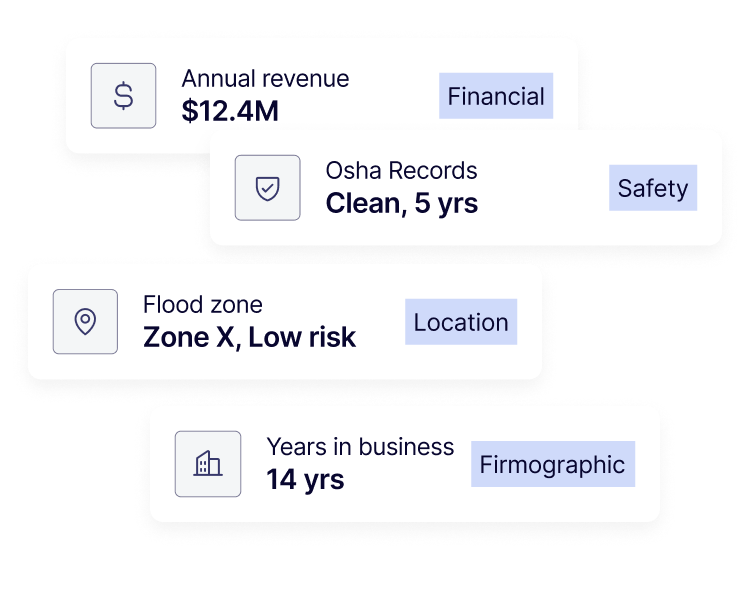
AI data-driven insights

How Insights and Analytics Work

Convr users benefit from a configurable dashboard view of their book within our underwriting workbench with out-of-the-box and/or custom reports. Insights are pulled from Convr’s data lake and exposed through Snowflake, Metabase or your choice of other Business Intelligence (BI) software.

Portfolio Views that Drive Decisions

Unlock Actionable Insights and Expedite Growth

Execute portfolio evaluation and decisions to adjust the composition of a book of business – from geographic exposure to key hazards and lines from deep insights.

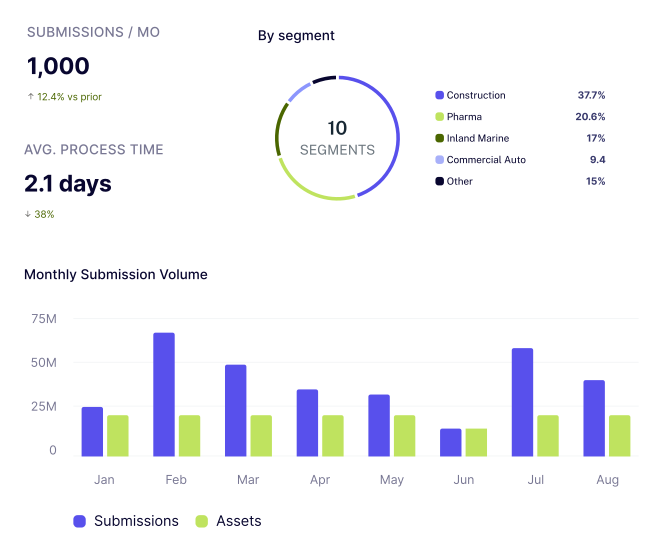
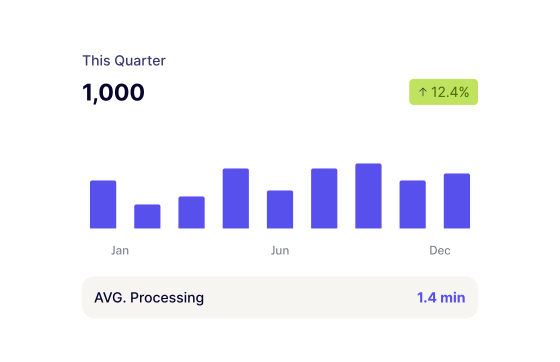
Submission Volume and Pipeline Health

Track volume trends and processing rates across your entire book – by line, by region, by NAICS – so you see pipeline health in real time, not in your next month-end report.

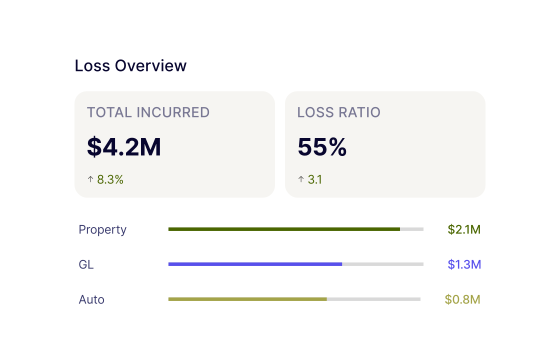
Loss Pattern Analysis

Analyze loss patterns across lines, segments, and time periods to identify adverse trends, surface opportunities to tighten appetite and/or adjust pricing proactively.

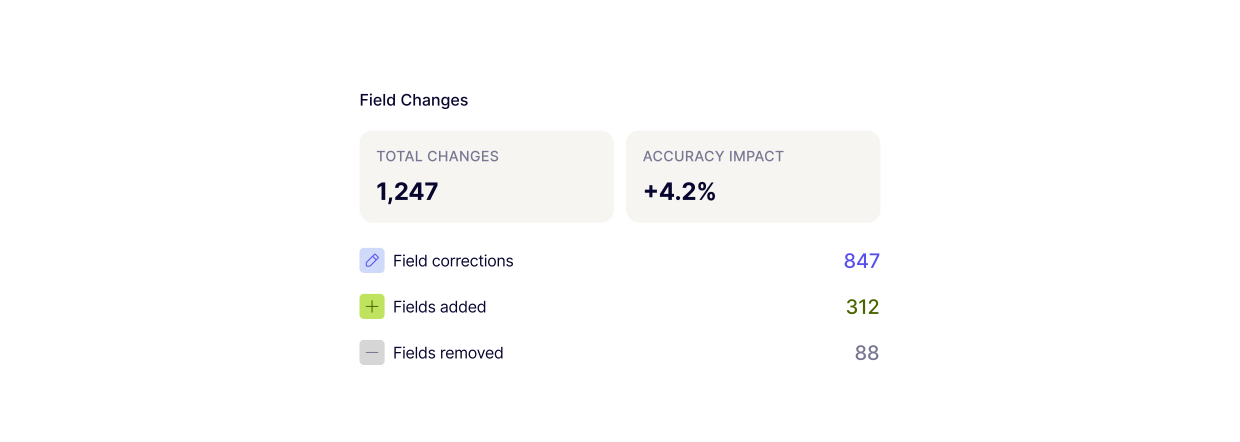
HITL Field Change Counts and Types

Track human review patterns to improve AI extraction accuracy over time.

Turn Data into Decisions

See the full picture of risk, performance, and opportunity – powered by AI-driven insights.

Knowledge is Power

Unleash real-time scrutiny of submission data and activity for inline evaluation of key risk characteristics as well as strategic decision-making.

“With Convr, we now start reviewing most submissions the same day we receive it. We can do this without the need for quality checks on our end because we know Convr has taken care of it.”

VP of Underwriting · Tangram
The Convr AI Underwriting Workbench

Modular Tools Your Underwriting Team Needs

Convr's modular workbench covers the full submission lifecycle from intake and enrichment to scoring, decisioning, and portfolio analysis, so underwriters work faster, smarter, and with more confidence at every step.

Intake

From Chaos to Structured Data in Minutes

risk 360

A Complete Picture of Every Risk

convr ai

Improve Productivity with Speed and Confidence

Resources

News and Insights

Insights, announcements, and trends shaping the commercial P&C insurance industry.

News

New Convr Survey Uncovers the Real Bottleneck: It's the Data, Not the People

CHICAGO (July 21, 2026) — Convr®, the leading AI-native underwriting workbench purpose-built for commercial P&C insurance, today released new findings from its 2026 Convr Insurance Talent and Tech Trends Survey that challenge a long-standing industry narrative.

While carriers continue to cite talent shortages as a primary obstacle to faster, more consistent underwriting, the survey of 211 commercial insurance professionals reveals that the real bottleneck is the data and technology environment underwriters are forced to work within.

Underwriters aren't slow. Their tools are.

When asked what slows down underwriting most at their companies today, respondents pointed overwhelmingly to data and tooling problems rather than people problems:

  • 35.1% cited manual data entry as a top barrier
  • 27.5% pointed to dated, legacy technology
  • 24.6% identified too many submission data sources
  • 23.2% named old processes
  • 21.3% reported lack of reliability and consistency in their current systems

Compounding the issue, 63% of carriers report operating in hybrid technology environments — a legacy core with cloud-based tools layered on top — and another 22.7% remain predominantly legacy on-premise. Only 14.2% describe their core underwriting platform as mostly modern SaaS or cloud-native.

The talent narrative deserves a closer look.

When asked about the hardest underwriting talent attributes to acquire, the top response was "high productivity" (50.2%), a quality that depends as much on the systems underwriters use as on the underwriters themselves. Other top-cited attributes included insurance expertise (43.1%), technology competence (38.9%), and the ability to source appropriate data (37%).

"For years, the industry has framed underwriting capacity as a talent problem and there's no question the talent pipeline matters," said John Stammen, Chief Executive Officer at Convr. "But our data tells a more honest story. Underwriters aren't slow. They're being asked to do extraordinary work on top of fragmented data, manual entry, and legacy systems that were never designed for the volume or complexity of today's P&C market. The carriers winning the productivity battle aren't the ones hiring more underwriters, they're the ones giving their underwriters the data, tools, and the workflow to actually do their jobs."

Underwriters know exactly what they need.

When asked what their underwriting teams would benefit most from, respondents pointed to capabilities that directly address the data and tooling gap:

  • 47.4% cited AI tool training
  • 46.9% cited pre-screened and enriched submissions
  • 45.5% cited simplified access to data
  • 42.2% cited better historical account and loss data
  • 36.5% cited improved data source visibility

These are not aspirational asks. They are foundational requirements and they map directly to the capabilities Convr delivers through its modular AI-powered underwriting workbench.

"Every carrier we work with has talented underwriters," Stammen added. "What they don't have yet is an environment that lets those underwriters operate to the best of their abilities. That's the gap Convr was built to close. When you take manual data entry off an underwriter's plate, you don't just save time. You unlock judgment, speed, and consistency at scale."

About the 2026 Convr Insurance Survey

The 2026 Convr Insurance Talent and Tech Trends Survey was conducted in April and reflects responses from 211 commercial insurance professionals working in property and casualty, with strong representation from leadership (35.1%), VP/Executive (37%), and management (42.2%) roles across carriers, MGAs, brokerages, and specialty markets.

For more information, visit convr.com.

Media Contact:
Alex Williams
alex.williams@convr.com
217-737-2782

Blog

How Commercial Insurers Identify Profitable Risks Faster

Commercial P&C insurers win on a simple equation: selecting risks whose premium and terms adequately cover expected losses, expenses, and capital costs, while staying competitive enough to bind. The hard part is that “good” risks rarely arrive in a neat, comparable form. Submissions come with inconsistent data, missing attachments, ambiguous class codes, and unstructured loss runs. Meanwhile, market cycles compress timelines. Brokers expect fast answers, underwriters face submission volumes that outpace capacity, and small delays can mean losing a desirable account to a competitor.

Identifying profitable risks faster is not just about quoting quickly. It is about making earlier, higher quality decisions with less rework. That requires an operating model that can separate high potential submissions from low fit ones within minutes, route the rest to the right expertise, and ensure pricing and coverage decisions remain governed and consistent. Speed without discipline can deteriorate results through adverse selection, misclassification, and leakage in terms and conditions.

The insurers that consistently improve new business performance typically do three things well. They build a triage pipeline that standardizes intake and enriches data early. They translate that data into consistent classification and risk signals that guide selection and pricing. And they maintain feedback loops at renewal so portfolio learnings continuously sharpen future decisions. The goal is a repeatable system where underwriting judgment is amplified, not replaced, by data and automation.

Defining “Profitable Risk” in Commercial P&C and the Constraints Insurers Face

A profitable commercial P&C risk is one that performs acceptably across time, not just at bind. Profitability is usually measured at the account and portfolio levels as underwriting profit, combined ratio, and risk-adjusted return on capital. At the individual risk level, “profitable” often means the expected loss cost plus expenses plus capital load is meaningfully below the expected premium net of commissions, while also fitting appetite and operational constraints.

The problem is that profitability is conditional. The same business may be profitable or unprofitable depending on location characteristics, construction details, safety programs, fleet composition, contract terms, limits, deductibles, and attachment points. Profitability also depends on the insurer’s portfolio concentration and reinsurance structure. A risk that looks attractive in isolation may be unattractive if it increases aggregation in a peril, industry, or corridor where the insurer is already heavy.

Insurers face constraints that make “fast and profitable” difficult. Submission quality is uneven, and the earliest data is often the noisiest. Underwriters have limited time to hunt for missing facts, yet the cost of a wrong decision is high. Regulations and internal governance require consistent documentation, fair and explainable decisioning, and adherence to filed rules where applicable. Distribution dynamics add pressure: brokers expect rapid indications, but will not tolerate frequent reversals after deeper review.

Then there is the reality of long-tail lines and delayed loss emergence. A book that appears profitable on new business can deteriorate over time if risk characteristics drift, pricing erodes, or claims inflate. That is why “profitable risk identification” must include a view of sustainability: stable operations, clear controls, consistent exposure bases, and transparency in financial and loss information.

In practice, profitable risk selection is less about a single perfect model and more about managing uncertainty. High-performing insurers reduce uncertainty early by standardizing intake, enriching submissions with third-party and internal data, and applying consistent classification and risk scoring. They also design workflows that match effort to opportunity, so that deep underwriting time is reserved for the submissions most likely to bind profitably.

Building a Fast Triage Pipeline: Data Sources, Submission Quality, and Intake Automation

Fast profitable decisions begin before underwriting touches the file. The first objective is triage: quickly determine whether a submission is in appetite, whether it is complete enough to assess, and what level of underwriting attention it deserves. This requires a pipeline that can ingest documents and data in many formats, extract key fields, validate them, and enrich them with external and internal sources.

A practical triage pipeline starts with intake automation. Submissions arrive as emails, ACORD forms, PDFs, spreadsheets, supplemental applications, loss runs, and schedules. Intelligent document processing can extract essentials such as named insured, operations description, locations, payroll and sales, vehicle counts, construction details, and prior carrier information. The key is not extraction alone but normalization. “Sales” may appear as revenue, gross receipts, or turnover, and the system must standardize definitions and units.

Next comes submission quality scoring. This is a simple but powerful mechanism: grade completeness, internal consistency, and credibility. Are class descriptions aligned with exposure bases? Do payroll totals reconcile across locations? Are loss runs current and covering the requested term? Are critical attachments present, such as supplemental questionnaires or safety program documentation? A quality score supports two outcomes: faster declines for unworkable submissions and targeted “missing info” requests that reduce back-and-forth.

Enrichment is the third leg. External data can validate and enhance what is submitted, for example business registration data, industry classification, web signals, property characteristics, geocoding, catastrophe and crime scores, lien information, and inspection history where available. Internal data, such as prior submissions, historical quotes, claims experience, and broker performance, can also add context. The goal is to transform a sparse submission into a decision-ready record.

Finally, the triage pipeline should route work intelligently. Straightforward, high fit submissions can move toward quick indication or automated referral rules. Complex risks can be directed to the right underwriter based on industry expertise, line complexity, and authority. Risks with red flags can be queued for specialist review. This routing reduces cycle time by preventing misassignment and by ensuring senior underwriters spend time where it creates the most value.

Done well, triage is not a gate that slows business. It is a filter and accelerator that improves speed, reduces rework, and protects underwriting capacity for the best opportunities.

Risk Selection at Speed: Classification, Scoring, and Pricing Governance

Once a submission is decision-ready, the next challenge is making a selection and pricing decision quickly without sacrificing governance. The foundation is consistent classification. Commercial accounts are frequently misclassified because operations are described in narrative form, class codes differ by line, and businesses change over time. Misclassification leads to wrong loss costs, wrong underwriting rules, and inconsistent appetite decisions. A robust approach uses a commercial insurance ontology, mapping business descriptions, NAICS or other industry labels, and underwriting classes into a harmonized view. This supports faster, more consistent risk segmentation and better downstream pricing.

Risk scoring then translates data into actionable signals. Not all scores are predictive, and not all are useful. The best scores are tied to clear decisions: appetite fit, expected loss ratio range, volatility, hazard indicators, and likelihood of underwriting actions such as requiring a protective safeguard or imposing a higher deductible. Scores should be explainable to underwriters and auditable for governance. A score that cannot be interpreted will either be ignored or misused.

Speed also depends on effective pricing governance. Underwriters need freedom to compete, but within guardrails that protect margin. Guardrails include minimum rate adequacy by segment, referral triggers for large credits or unusual terms, and consistent handling of exposure changes. A practical method is to embed “pricing reason codes” in the workflow, such as credit for strong safety program, debit for adverse loss frequency, or adjustment for unusual contractual risk transfer. This creates documentation discipline and a dataset for later portfolio learning.

Another lever is decision tiering. Many submissions do not require the same level of scrutiny. Small, standard risks with strong data can follow a low-touch path with automated checks and quick underwriter confirmation. Mid-market risks can use structured underwriting templates and guided questions driven by the ontology and risk signals. Complex risks can trigger deeper review, loss control consultation, or specialized modeling. The insurer still underwrites all risks, but not all risks consume the same time.

Speed must also be paired with consistency in coverage and terms. Leakage often occurs through manuscript endorsements, inconsistent additional insured language, or lax application of exclusions. A guided system can recommend standard forms based on operations and highlight common gaps between requested and acceptable terms. Underwriters can deviate, but deviations become visible and reviewable.

When classification, scoring, and governance work together, underwriters spend less time assembling facts and more time applying judgment. The result is faster decisions that are also more repeatable, defensible, and profitable.

Monitoring for Renewal Profitability: Material Change Detection and Portfolio Feedback Loops

Profitability is not locked in at bind. Commercial insureds change: payroll grows, operations expand, subcontracting increases, new locations open, fleets change, and contracts evolve. Some changes increase exposure in predictable ways, while others fundamentally alter the risk profile. Renewal is where insurers can protect profitability by detecting material changes early and adjusting pricing, terms, or appetite decisions accordingly.

Material change detection starts with comparing current period data to prior period baselines. The baseline includes exposure measures, class mix, locations, and loss experience. Changes can be identified through updated applications, audits, endorsements, and claims, but also through external data signals. For example, a business website that suddenly advertises new services may indicate an operations shift. A new address may indicate a new location with different hazard characteristics. Filings or public data may reveal ownership changes or rapid growth. The point is not to surveil but to reduce surprises.

A structured renewal workflow flags changes that matter. Not every delta is material. The workflow should focus on changes that have a meaningful impact on expected loss or volatility, such as higher hazard operations, significant payroll or sales growth, new subcontracting practices, new vehicle types, or worsening loss frequency. These flags can drive targeted questions to the broker and insured, reducing renewal friction while ensuring the underwriter gets the right information.

Portfolio feedback loops then convert renewal outcomes into better new business decisions. This includes tracking how early-stage scores and classifications correlate with later loss results, retention, premium adequacy, and claim severity. If a segment consistently deteriorates after renewal due to exposure drift, the appetite or pricing assumptions should be updated. If certain brokers deliver better data quality and better-performing business, distribution strategy and triage prioritization can reflect that. If particular endorsements or terms correlate with unexpected losses, coverage governance can be tightened.

Operationally, feedback loops require clean data capture. Renewal underwriters need to record the reason for key decisions: why a rate change occurred, why terms changed, why an account was non-renewed. Claims and underwriting data need a shared vocabulary so patterns can be detected. Without structured decision data, portfolio learning becomes anecdotal and slow.

When renewal monitoring and feedback loops are mature, insurers improve profitability in two ways. They reduce leakage by catching exposure changes before they become underpriced. And they improve future speed by refining triage and scoring so the best risks are identified earlier with higher confidence.

FAQs

How do insurers define “in appetite” quickly without oversimplifying the risk?

Most insurers begin with a high-level appetite statement, but speed comes from translating that statement into operational rules tied to data fields. “In appetite” becomes a set of checks across industry classification, revenue or payroll thresholds, location and occupancy characteristics, loss history, and required controls. To avoid oversimplification, the rules should include referral bands rather than binary accept or decline. For example, a class might be acceptable generally, but referrals trigger when certain operations are present or when loss frequency exceeds a threshold. The fastest systems also use structured extraction from submissions so these checks run immediately, and they attach an explanation to each outcome so underwriters and brokers understand what drove the result.

What data matters most for faster profitable risk selection in commercial P&C?

The most valuable data is the data that reduces uncertainty early. That usually includes a clear description of operations, accurate exposure bases by class, complete location and schedule information, current loss runs with meaningful narratives, and prior carrier and pricing context. Beyond submission data, enrichment that validates the business and clarifies hazards often has outsized impact, such as industry classification alignment, geocoding for hazard context, property characteristics for building-related lines, and indicators of operational complexity like subcontracting reliance. Insurers also benefit from internal performance data: how similar accounts performed in loss ratio, what terms were applied, and what pricing actions were required at renewal. The key is not collecting everything, but prioritizing the minimum dataset that enables confident selection and appropriate terms.

How can automation speed underwriting without causing adverse selection?

Automation reduces adverse selection when it improves consistency and frees underwriters to focus on judgment-heavy decisions. The safer pattern is “automation with guardrails.” Use automation to extract and validate data, score submission quality, detect inconsistencies, and surface risk signals. Then apply governed rules for appetite and pricing thresholds, with clear referral triggers. Adverse selection risk rises when automation is used to auto-quote broadly without strong data validation or when models are treated as truth rather than decision support. It also rises if speed incentives cause underwriters to skip documentation or accept weak data. A balanced approach measures not only quote speed, but also bind quality indicators such as data completeness at bind, exception rates, and early claims emergence.

What is a commercial insurance ontology and why does it matter for speed?

A commercial insurance ontology is a structured framework that connects business concepts insurers care about, such as operations, hazards, classes, exposures, coverage needs, and underwriting rules. It matters because commercial submissions are messy and inconsistent. Two brokers may describe the same business in different words, and different lines may use different class systems. An ontology helps normalize those descriptions into a consistent classification and set of attributes. That consistency is what enables faster triage, better routing, reliable analytics, and more consistent pricing and coverage decisions. It also improves explainability: underwriters can see why a business was classified a certain way and what hazards or rules are associated with that classification, making decisions quicker and more defensible.

How do insurers detect material change at renewal without creating extra work for brokers?

The best renewal processes start by reusing what the insurer already knows and focusing outreach only where change is likely and meaningful. Material change detection compares current signals to prior period baselines and flags only the deltas that matter, such as significant exposure growth, class mix shifts, new locations, or adverse loss trends. Instead of sending long supplemental applications to every account, the insurer can generate targeted questions tied to the flagged change. Brokers experience this as fewer, more relevant requests. Internally, underwriters save time because they are not re-collecting stable data each year. The process works best when renewal data is structured and when prior-year exposures, terms, and decision notes are easy to access and compare.

Conclusion

Commercial insurers identify profitable risks faster when they treat speed as a system design problem, not an individual underwriter heroics problem. Profitability depends on selecting risks that fit appetite, are priced with adequate margin for their expected loss and volatility, and remain stable or at least transparent as they evolve. The constraints are real: inconsistent submissions, limited underwriting capacity, broker time pressure, governance requirements, and the long-tail nature of many commercial lines.

A high-performing approach starts with a fast triage pipeline that automates intake, extracts and normalizes data, scores submission quality, enriches key attributes, and routes work to the right expertise. It continues with consistent classification and risk scoring that translate messy information into governed decisions, supported by pricing guardrails and clear documentation. And it extends through renewal with material change detection and portfolio feedback loops that sharpen future appetite, pricing, and workflow choices.

Insurers that build these capabilities can reduce cycle time while improving decision quality, because underwriters spend less time chasing missing facts and more time applying judgment to well-structured information. To learn more about modern underwriting workbenches and how they support faster, governed decisions, visit https://convr.com/.

Blog

How AI Extracts Data From Insurance Submissions

Insurance underwriting still begins with a familiar bottleneck: the submission. A broker sends a bundle of documents, emails, spreadsheets, and attachments that describe an account, and the carrier or MGA must turn that bundle into structured data that can be evaluated, priced, and quoted. The challenge is not that the information is missing. It is that it is scattered, duplicated, inconsistently formatted, and mixed with narrative descriptions that are hard to compare across accounts. A single submission can include dozens of data points that matter to risk selection and pricing, plus supporting context that helps an underwriter understand operations, controls, and loss drivers.

AI changes the nature of this work by treating submission intake as a data engineering problem rather than a manual reading task. Instead of relying on someone to interpret every field and retype it into systems, AI can extract key entities and attributes, normalize them to standard definitions, and present them as a coherent risk profile with traceability back to the original source. That shift makes it possible to move faster while improving consistency, because the same extraction logic can be applied across different document types, formats, and lines of business. The most effective implementations combine document understanding, classification, and validation so the results are not just fast, but also trustworthy enough for real underwriting decisions.

What Counts as an Insurance Submission and Where the Data Lives

An insurance submission is best understood as the complete set of materials used to evaluate and quote a risk, not just a single form. Depending on the line and distribution channel, a submission may include an ACORD application, supplemental questionnaires, schedules of values, loss runs, prior policies, inspection reports, financial statements, driver lists, certificates, and a long email thread that clarifies open questions. It often contains documents that were originally created for other purposes, like payroll reports or lease agreements, but that carry underwriting signals.

The data in a submission lives in multiple “containers.” Some is already structured, like spreadsheet schedules or ACORD XML. Some is semi-structured, like PDFs with tables, checkboxes, and repeated labels. Some is unstructured narrative text, like a broker email describing operations, upcoming changes, or past incidents. Attachments can be scanned images, which adds the complication of OCR quality and skewed or noisy pages. Even when a PDF looks digital, it may be a flattened image with no selectable text.

Submissions also contain competing versions of the truth. A value might appear in a narrative, a questionnaire, and a schedule, each with a slightly different number or effective date. Business descriptions vary by writer and can drift away from the classification codes used by underwriting rules and rating. Locations, payroll, revenue, and vehicle counts may be given as ranges, estimates, or totals that do not reconcile across documents. The underwriting task is to reconcile these conflicts, determine what is current, and capture the data needed for appetite, triage, pricing inputs, and referral decisions.

AI-assisted intake starts by recognizing that the submission is a dataset distributed across documents. The goal is to turn that distributed dataset into a single structured representation of the account, with clear source attribution and confidence, so downstream workflows can run reliably.

How AI Extracts and Structures Data From Submission Documents

AI extraction typically begins with ingestion and document organization. Files arrive through email, portals, or APIs, and the system must group them into a single submission, deduplicate, and identify document types. Document classification models look at layout, text cues, and metadata to label files as ACORD forms, loss runs, schedules, questionnaires, or correspondence. Accurate classification matters because it selects the right extraction strategy, such as table parsing for schedules or entity extraction for narrative text.

Next comes text acquisition. For digital PDFs, text can be extracted directly. For scanned documents, OCR is used to convert images into text while preserving layout coordinates. Modern OCR pipelines also detect page rotation, columns, headers, and tables, and they output tokens with bounding boxes. Those layout signals are crucial because many underwriting fields are defined by their position relative to labels and table structure, not just by the words themselves.

With text and layout available, AI models extract entities and attributes. There are two common approaches that are often combined. One is key-value extraction, which finds labeled fields like “FEIN,” “Years in business,” or “Total payroll” and captures the corresponding value. The other is semantic extraction, which identifies entities like named insured, locations, operations, building details, limits, deductibles, and loss events, even when the document does not use consistent labels. Table understanding is a specialized capability that extracts rows and columns from schedules of vehicles, properties, or equipment while preserving relationships like per-item value and address.

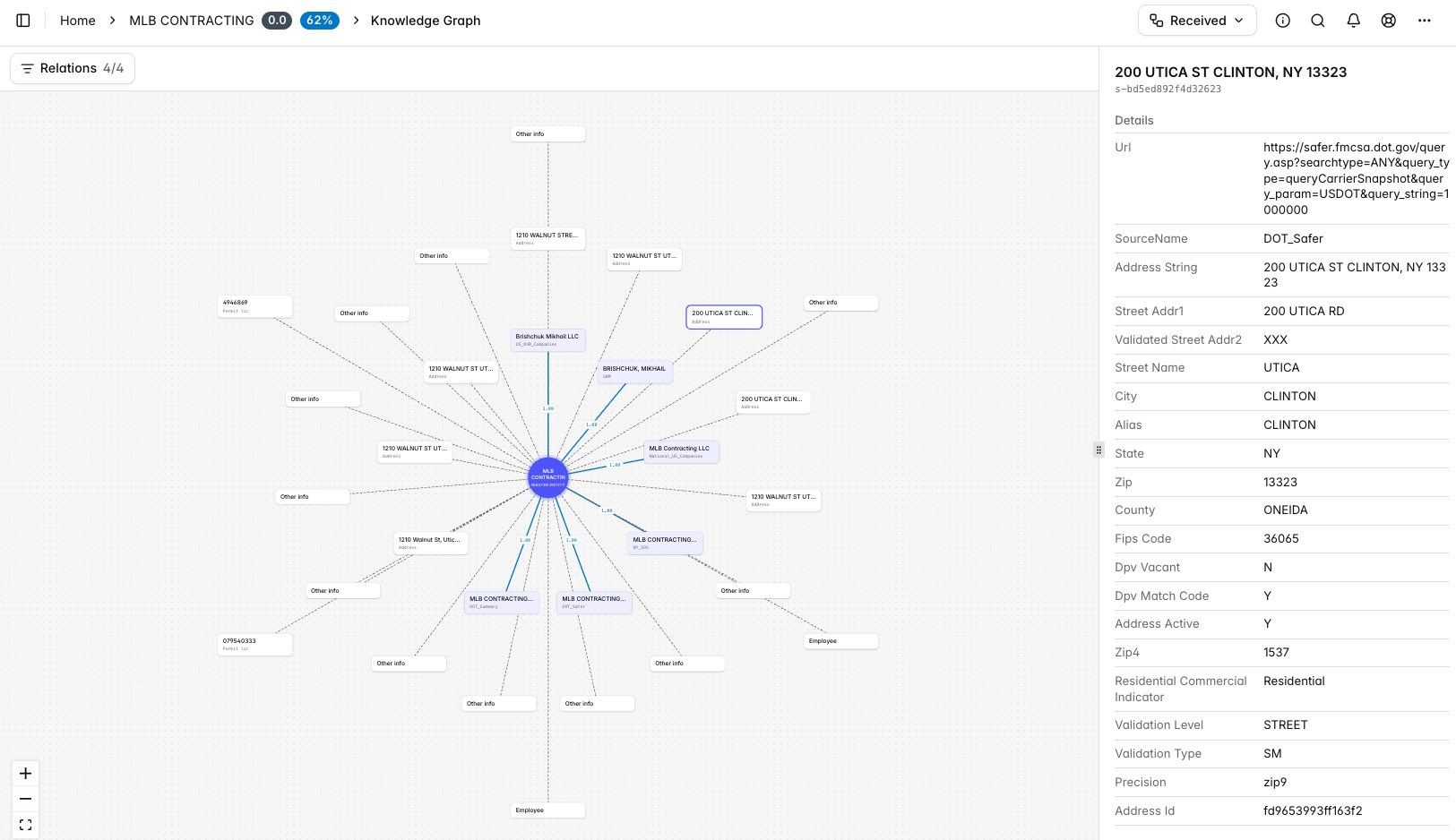
Structuring is where the biggest payoff happens. Extracted values must be normalized into canonical formats: dates standardized, currencies parsed, addresses validated, units reconciled, and totals computed. Business descriptions can be mapped to standardized classifications used for underwriting rules and rating. When the system is powered by an insurance-specific ontology, it can represent the account as a graph of related objects, such as a policy period with coverages, a set of locations with exposures, and operational attributes that drive risk scoring. That structure supports downstream automation like appetite checks, rule-based referrals, and prefill into rating systems.

Finally, a practical extraction system generates an “evidence layer.” Every extracted value should carry provenance such as document name, page number, and highlighted text region, plus a confidence score and any conflicts detected across sources. That evidence is what allows underwriters to trust the output and quickly verify or correct it.

Validation, Auditability, and Regulatory Considerations for AI-Extracted Submission Data

Extracted submission data is only useful if it can be trusted, explained, and reviewed. Validation is the set of checks that ensure extracted fields are plausible, consistent, and aligned with underwriting expectations. Some checks are basic formatting, like making sure a FEIN has the right length or a date parses correctly. Others are domain-specific, like ensuring payroll totals reconcile with class code breakdowns, that building values are consistent with construction and square footage ranges, or that the number of vehicles matches a schedule count. Validation can also use cross-document logic, such as verifying that the effective date in a quote request matches the dates referenced in loss runs and prior policy declarations.

Conflict resolution is a major component of validation. When two documents disagree, the system should not silently pick one. Instead, it should surface the conflict, show the competing sources, and apply a clear rule set. Sometimes recency matters, such as preferring the most recent supplemental. Sometimes document authority matters, such as prioritizing a signed application over an email estimate. In many workflows, the best approach is to present the discrepancy and let the underwriter decide, while the system tracks the final selected value.

Auditability depends on traceability and versioning. Underwriting files evolve as brokers send updates. An AI system should retain snapshots of extracted data by submission version, track what changed, and maintain links back to the exact source excerpt that supported the value at the time of decision. This enables defensibility in post-bind reviews, claims disputes, and internal audits. It also reduces rework because renewals can be compared against prior extracted profiles to identify material changes.

Regulatory considerations are largely about governance, privacy, and fairness. Submission documents can contain sensitive personal information, and handling must comply with data minimization, access controls, retention policies, and encryption. Models should be monitored for consistent behavior, and organizations should document how AI is used in the workflow, especially where it influences decisions like triage, appetite, or pricing inputs. Human oversight remains central. AI can propose extracted values and risk indicators, but underwriting decisions should be reviewable, and the organization should be able to explain what data was used and why. Practical controls include role-based permissions, redaction of unnecessary PII, logging of model outputs and edits, and clear procedures for correcting errors.

Common Failure Modes and How Teams Mitigate Them in Underwriting Workflows

Even strong AI extraction systems fail in predictable ways. One common failure is poor input quality. Low-resolution scans, fax artifacts, skewed pages, and handwritten notes can degrade OCR and lead to missing or incorrect values. Mitigation starts with ingestion controls such as minimum quality thresholds, automatic image enhancement, and prompts to brokers when documents are unreadable. Some teams also route low-quality documents to a human-assisted capture path to prevent silent errors.

Another failure mode is document variability. The same information can appear in countless formats, and carriers often see custom broker templates. Models trained on limited templates may mislabel fields or misread tables with merged cells and multi-line headers. Teams mitigate this by combining machine learning with rules that leverage layout anchors, maintaining a library of known templates, and continuously retraining models on new examples. Active learning workflows, where corrections made by underwriters feed back into training data, can improve coverage over time.

A third failure is semantic ambiguity. Terms like “sales,” “revenue,” and “gross receipts” may be used interchangeably, but they can have different underwriting meanings. “Total insured value” might refer to building plus contents in one context and only scheduled equipment in another. Mitigation requires a domain ontology and contextual extraction, where the model uses surrounding cues, document type, and line of business to assign the right meaning. It also helps to capture units and time periods explicitly, such as annual revenue for the most recent fiscal year.

Cross-field inconsistencies can also break downstream workflows. For example, an address may be extracted incorrectly, leading to geocoding errors and misapplied territory factors. Or a deductible may be captured without noting whether it applies per occurrence or aggregate. Teams mitigate this with validation rules, reference data enrichment, and “must-verify” flags when confidence is low or when downstream impact is high.

Finally, there is workflow risk: even correct extraction can be ignored if it does not fit how underwriters work. If users cannot quickly see evidence, correct values, and understand what changed, they will revert to manual review. Mitigation is a human-centered design that emphasizes side-by-side evidence, fast editing, clear confidence indicators, and seamless export into underwriting and rating systems. The best teams treat AI as a co-pilot that reduces reading and typing, not as a black box that replaces judgment.

FAQs

How is AI different from traditional OCR and form recognition in submissions?

Traditional OCR converts images to text, and older form recognition tries to locate fields based on fixed templates. AI-based submission intake goes further by understanding both language and document structure across many formats. It can classify document types, extract entities even when labels change, and interpret relationships in tables like schedules of vehicles or locations. It also normalizes data into consistent types, such as standardizing dates, addresses, and monetary values, and it can map operations to standardized business classifications. Another key difference is evidence and confidence. A modern AI system can attach provenance like page and excerpt, and it can flag uncertain values or conflicts across documents. In practice, that means fewer brittle template dependencies, better handling of broker variability, and a workflow where underwriters review highlighted evidence instead of rekeying everything.

What kinds of submission fields are most suitable for AI extraction, and which are hardest?

Fields that are labeled, repeated, and formatted consistently tend to be easiest, such as named insured, addresses, policy dates, limits, deductibles, and many schedule columns like VIN, year, make, and value. Loss run data also works well when the table structure is clear, enabling extraction of loss dates, amounts, causes, and status. Harder fields are those that depend on interpretation, such as describing operations, identifying material changes, or determining whether a control is “adequate” based on narrative wording. Tables become difficult when they have merged cells, footnotes, or multi-level headers, or when totals are embedded in narrative rather than listed clearly. The best approach is hybrid: use AI for broad extraction and normalization, then design review checkpoints for ambiguous items with high underwriting impact.

How do teams ensure the extracted data is accurate enough to trust for quoting?

Accuracy comes from layered controls, not just one model score. Teams typically combine confidence thresholds, validation rules, and source-based verification. For example, if the system extracts a payroll figure, it can check that it is numeric, that it aligns with the sum of class code subtotals, and that it matches the time period stated in the document. When documents disagree, the system should surface the conflict with evidence, not guess silently. Underwriters also need an efficient way to confirm values, such as clicking a field to see the highlighted excerpt and adjusting it when needed. Over time, capturing those corrections and using them to retrain models improves accuracy on the specific mix of broker templates and lines of business the team sees most often.

Can AI help identify material changes at renewal from submission documents?

Yes, if the extracted submission data is structured and versioned. The core capability is comparing the prior extracted risk profile to the current one and detecting changes in exposure and operations. Examples include new locations, increases in revenue or payroll, changes in construction or occupancy, added vehicles or drivers, new products or services, or changes in safety controls. AI helps by pulling those signals from multiple documents, including emails and supplemental questionnaires, and presenting a concise change summary with evidence links. The key is to store prior-year extracted data in a consistent schema so comparisons are meaningful, and to track document provenance so an underwriter can see exactly where the change was stated. This supports faster renewal triage and reduces the risk of missing subtle but important updates.

What role does an insurance ontology play in extracting submission data?

An ontology provides a shared set of definitions and relationships that turns raw extracted text into underwriting-ready structure. Instead of storing isolated fields, the system can represent concepts like accounts, locations, coverages, exposures, loss events, and operational attributes, and how they relate. That makes normalization more consistent, such as distinguishing named insured from additional insured, separating mailing address from risk location, or associating scheduled values with the correct location and coverage. It also supports classification, such as mapping business descriptions to standardized categories used for appetite and risk scoring. When extraction is ontology-driven, downstream workflows benefit because rules, analytics, and integrations can rely on consistent meaning even when the original documents are inconsistent.

Conclusion

AI-driven extraction turns insurance submissions from a slow, manual reading exercise into a repeatable process that produces structured, validated data with clear evidence. It starts by organizing the submission, classifying documents, and converting content into machine-readable text while preserving layout. It then extracts key entities and tables, normalizes values into consistent formats, and maps them into a risk profile that underwriting systems can use. The most important ingredient is not speed alone, but trust: conflict detection, validation rules, provenance, and versioning make it possible to review, audit, and defend decisions. Just as importantly, teams reduce operational risk by designing workflows that highlight evidence, support quick corrections, and focus human attention on ambiguity rather than data entry.

Common failure modes are manageable when treated as expected realities: low-quality scans, template variability, semantic ambiguity, and cross-field inconsistencies. Mitigations like quality controls, hybrid extraction methods, ontology-driven structuring, and continuous learning from user corrections allow performance to improve over time. The result is a workflow where underwriters can move faster without losing rigor, and where renewals can be compared consistently to identify meaningful changes.

To see how a modular AI underwriting and intelligent document automation workbench approaches submission extraction with structured data, evidence, and underwriting workflow fit, visit https://convr.com/.

Frequently Asked Questions

Find quick answers to common questions about our platform, capabilities, and implementation.

What data powers the dashboards—what’s included in the insight layer?

Insights are derived from all the data captured during the submission‑to‑quote process, combined with Convr’s data lake, to provide clarity on process/production quality and risk exposures to optimize distribution, products, pricing, and policies.

What reporting and BI options exist?

Convr delivers portfolio and operational analysis through Snowflake or other chosen BI reporting tools.

Can insights support strategic portfolio decisions?

 Insights support portfolio & operational strategic assessments – including pricing adequacy, line of business, geographic and producer evaluations, and production metrics – to inform business health, investment focus, and growth opportunities.

Explore Our Resources

Turn knowledge into action with resources built for smarter, faster underwriting.