Resources for Modern Underwriting Teams

blogs

Insights from the Front Lines of Underwriting

XX MIN READ

How Commercial Insurers Identify Profitable Risks Faster

Commercial P&C insurers win on a simple equation: selecting risks whose premium and terms adequately cover expected losses, expenses, and capital costs, while staying competitive enough to bind. The hard part is that “good” risks rarely arrive in a neat, comparable form. Submissions come with inconsistent data, missing attachments, ambiguous class codes, and unstructured loss runs. Meanwhile, market cycles compress timelines. Brokers expect fast answers, underwriters face submission volumes that outpace capacity, and small delays can mean losing a desirable account to a competitor.

Identifying profitable risks faster is not just about quoting quickly. It is about making earlier, higher quality decisions with less rework. That requires an operating model that can separate high potential submissions from low fit ones within minutes, route the rest to the right expertise, and ensure pricing and coverage decisions remain governed and consistent. Speed without discipline can deteriorate results through adverse selection, misclassification, and leakage in terms and conditions.

The insurers that consistently improve new business performance typically do three things well. They build a triage pipeline that standardizes intake and enriches data early. They translate that data into consistent classification and risk signals that guide selection and pricing. And they maintain feedback loops at renewal so portfolio learnings continuously sharpen future decisions. The goal is a repeatable system where underwriting judgment is amplified, not replaced, by data and automation.

Defining “Profitable Risk” in Commercial P&C and the Constraints Insurers Face

A profitable commercial P&C risk is one that performs acceptably across time, not just at bind. Profitability is usually measured at the account and portfolio levels as underwriting profit, combined ratio, and risk-adjusted return on capital. At the individual risk level, “profitable” often means the expected loss cost plus expenses plus capital load is meaningfully below the expected premium net of commissions, while also fitting appetite and operational constraints.

The problem is that profitability is conditional. The same business may be profitable or unprofitable depending on location characteristics, construction details, safety programs, fleet composition, contract terms, limits, deductibles, and attachment points. Profitability also depends on the insurer’s portfolio concentration and reinsurance structure. A risk that looks attractive in isolation may be unattractive if it increases aggregation in a peril, industry, or corridor where the insurer is already heavy.

Insurers face constraints that make “fast and profitable” difficult. Submission quality is uneven, and the earliest data is often the noisiest. Underwriters have limited time to hunt for missing facts, yet the cost of a wrong decision is high. Regulations and internal governance require consistent documentation, fair and explainable decisioning, and adherence to filed rules where applicable. Distribution dynamics add pressure: brokers expect rapid indications, but will not tolerate frequent reversals after deeper review.

Then there is the reality of long-tail lines and delayed loss emergence. A book that appears profitable on new business can deteriorate over time if risk characteristics drift, pricing erodes, or claims inflate. That is why “profitable risk identification” must include a view of sustainability: stable operations, clear controls, consistent exposure bases, and transparency in financial and loss information.

In practice, profitable risk selection is less about a single perfect model and more about managing uncertainty. High-performing insurers reduce uncertainty early by standardizing intake, enriching submissions with third-party and internal data, and applying consistent classification and risk scoring. They also design workflows that match effort to opportunity, so that deep underwriting time is reserved for the submissions most likely to bind profitably.

Building a Fast Triage Pipeline: Data Sources, Submission Quality, and Intake Automation

Fast profitable decisions begin before underwriting touches the file. The first objective is triage: quickly determine whether a submission is in appetite, whether it is complete enough to assess, and what level of underwriting attention it deserves. This requires a pipeline that can ingest documents and data in many formats, extract key fields, validate them, and enrich them with external and internal sources.

A practical triage pipeline starts with intake automation. Submissions arrive as emails, ACORD forms, PDFs, spreadsheets, supplemental applications, loss runs, and schedules. Intelligent document processing can extract essentials such as named insured, operations description, locations, payroll and sales, vehicle counts, construction details, and prior carrier information. The key is not extraction alone but normalization. “Sales” may appear as revenue, gross receipts, or turnover, and the system must standardize definitions and units.

Next comes submission quality scoring. This is a simple but powerful mechanism: grade completeness, internal consistency, and credibility. Are class descriptions aligned with exposure bases? Do payroll totals reconcile across locations? Are loss runs current and covering the requested term? Are critical attachments present, such as supplemental questionnaires or safety program documentation? A quality score supports two outcomes: faster declines for unworkable submissions and targeted “missing info” requests that reduce back-and-forth.

Enrichment is the third leg. External data can validate and enhance what is submitted, for example business registration data, industry classification, web signals, property characteristics, geocoding, catastrophe and crime scores, lien information, and inspection history where available. Internal data, such as prior submissions, historical quotes, claims experience, and broker performance, can also add context. The goal is to transform a sparse submission into a decision-ready record.

Finally, the triage pipeline should route work intelligently. Straightforward, high fit submissions can move toward quick indication or automated referral rules. Complex risks can be directed to the right underwriter based on industry expertise, line complexity, and authority. Risks with red flags can be queued for specialist review. This routing reduces cycle time by preventing misassignment and by ensuring senior underwriters spend time where it creates the most value.

Done well, triage is not a gate that slows business. It is a filter and accelerator that improves speed, reduces rework, and protects underwriting capacity for the best opportunities.

Risk Selection at Speed: Classification, Scoring, and Pricing Governance

Once a submission is decision-ready, the next challenge is making a selection and pricing decision quickly without sacrificing governance. The foundation is consistent classification. Commercial accounts are frequently misclassified because operations are described in narrative form, class codes differ by line, and businesses change over time. Misclassification leads to wrong loss costs, wrong underwriting rules, and inconsistent appetite decisions. A robust approach uses a commercial insurance ontology, mapping business descriptions, NAICS or other industry labels, and underwriting classes into a harmonized view. This supports faster, more consistent risk segmentation and better downstream pricing.

Risk scoring then translates data into actionable signals. Not all scores are predictive, and not all are useful. The best scores are tied to clear decisions: appetite fit, expected loss ratio range, volatility, hazard indicators, and likelihood of underwriting actions such as requiring a protective safeguard or imposing a higher deductible. Scores should be explainable to underwriters and auditable for governance. A score that cannot be interpreted will either be ignored or misused.

Speed also depends on effective pricing governance. Underwriters need freedom to compete, but within guardrails that protect margin. Guardrails include minimum rate adequacy by segment, referral triggers for large credits or unusual terms, and consistent handling of exposure changes. A practical method is to embed “pricing reason codes” in the workflow, such as credit for strong safety program, debit for adverse loss frequency, or adjustment for unusual contractual risk transfer. This creates documentation discipline and a dataset for later portfolio learning.

Another lever is decision tiering. Many submissions do not require the same level of scrutiny. Small, standard risks with strong data can follow a low-touch path with automated checks and quick underwriter confirmation. Mid-market risks can use structured underwriting templates and guided questions driven by the ontology and risk signals. Complex risks can trigger deeper review, loss control consultation, or specialized modeling. The insurer still underwrites all risks, but not all risks consume the same time.

Speed must also be paired with consistency in coverage and terms. Leakage often occurs through manuscript endorsements, inconsistent additional insured language, or lax application of exclusions. A guided system can recommend standard forms based on operations and highlight common gaps between requested and acceptable terms. Underwriters can deviate, but deviations become visible and reviewable.

When classification, scoring, and governance work together, underwriters spend less time assembling facts and more time applying judgment. The result is faster decisions that are also more repeatable, defensible, and profitable.

Monitoring for Renewal Profitability: Material Change Detection and Portfolio Feedback Loops

Profitability is not locked in at bind. Commercial insureds change: payroll grows, operations expand, subcontracting increases, new locations open, fleets change, and contracts evolve. Some changes increase exposure in predictable ways, while others fundamentally alter the risk profile. Renewal is where insurers can protect profitability by detecting material changes early and adjusting pricing, terms, or appetite decisions accordingly.

Material change detection starts with comparing current period data to prior period baselines. The baseline includes exposure measures, class mix, locations, and loss experience. Changes can be identified through updated applications, audits, endorsements, and claims, but also through external data signals. For example, a business website that suddenly advertises new services may indicate an operations shift. A new address may indicate a new location with different hazard characteristics. Filings or public data may reveal ownership changes or rapid growth. The point is not to surveil but to reduce surprises.

A structured renewal workflow flags changes that matter. Not every delta is material. The workflow should focus on changes that have a meaningful impact on expected loss or volatility, such as higher hazard operations, significant payroll or sales growth, new subcontracting practices, new vehicle types, or worsening loss frequency. These flags can drive targeted questions to the broker and insured, reducing renewal friction while ensuring the underwriter gets the right information.

Portfolio feedback loops then convert renewal outcomes into better new business decisions. This includes tracking how early-stage scores and classifications correlate with later loss results, retention, premium adequacy, and claim severity. If a segment consistently deteriorates after renewal due to exposure drift, the appetite or pricing assumptions should be updated. If certain brokers deliver better data quality and better-performing business, distribution strategy and triage prioritization can reflect that. If particular endorsements or terms correlate with unexpected losses, coverage governance can be tightened.

Operationally, feedback loops require clean data capture. Renewal underwriters need to record the reason for key decisions: why a rate change occurred, why terms changed, why an account was non-renewed. Claims and underwriting data need a shared vocabulary so patterns can be detected. Without structured decision data, portfolio learning becomes anecdotal and slow.

When renewal monitoring and feedback loops are mature, insurers improve profitability in two ways. They reduce leakage by catching exposure changes before they become underpriced. And they improve future speed by refining triage and scoring so the best risks are identified earlier with higher confidence.

FAQs

How do insurers define “in appetite” quickly without oversimplifying the risk?

Most insurers begin with a high-level appetite statement, but speed comes from translating that statement into operational rules tied to data fields. “In appetite” becomes a set of checks across industry classification, revenue or payroll thresholds, location and occupancy characteristics, loss history, and required controls. To avoid oversimplification, the rules should include referral bands rather than binary accept or decline. For example, a class might be acceptable generally, but referrals trigger when certain operations are present or when loss frequency exceeds a threshold. The fastest systems also use structured extraction from submissions so these checks run immediately, and they attach an explanation to each outcome so underwriters and brokers understand what drove the result.

What data matters most for faster profitable risk selection in commercial P&C?

The most valuable data is the data that reduces uncertainty early. That usually includes a clear description of operations, accurate exposure bases by class, complete location and schedule information, current loss runs with meaningful narratives, and prior carrier and pricing context. Beyond submission data, enrichment that validates the business and clarifies hazards often has outsized impact, such as industry classification alignment, geocoding for hazard context, property characteristics for building-related lines, and indicators of operational complexity like subcontracting reliance. Insurers also benefit from internal performance data: how similar accounts performed in loss ratio, what terms were applied, and what pricing actions were required at renewal. The key is not collecting everything, but prioritizing the minimum dataset that enables confident selection and appropriate terms.

How can automation speed underwriting without causing adverse selection?

Automation reduces adverse selection when it improves consistency and frees underwriters to focus on judgment-heavy decisions. The safer pattern is “automation with guardrails.” Use automation to extract and validate data, score submission quality, detect inconsistencies, and surface risk signals. Then apply governed rules for appetite and pricing thresholds, with clear referral triggers. Adverse selection risk rises when automation is used to auto-quote broadly without strong data validation or when models are treated as truth rather than decision support. It also rises if speed incentives cause underwriters to skip documentation or accept weak data. A balanced approach measures not only quote speed, but also bind quality indicators such as data completeness at bind, exception rates, and early claims emergence.

What is a commercial insurance ontology and why does it matter for speed?

A commercial insurance ontology is a structured framework that connects business concepts insurers care about, such as operations, hazards, classes, exposures, coverage needs, and underwriting rules. It matters because commercial submissions are messy and inconsistent. Two brokers may describe the same business in different words, and different lines may use different class systems. An ontology helps normalize those descriptions into a consistent classification and set of attributes. That consistency is what enables faster triage, better routing, reliable analytics, and more consistent pricing and coverage decisions. It also improves explainability: underwriters can see why a business was classified a certain way and what hazards or rules are associated with that classification, making decisions quicker and more defensible.

How do insurers detect material change at renewal without creating extra work for brokers?

The best renewal processes start by reusing what the insurer already knows and focusing outreach only where change is likely and meaningful. Material change detection compares current signals to prior period baselines and flags only the deltas that matter, such as significant exposure growth, class mix shifts, new locations, or adverse loss trends. Instead of sending long supplemental applications to every account, the insurer can generate targeted questions tied to the flagged change. Brokers experience this as fewer, more relevant requests. Internally, underwriters save time because they are not re-collecting stable data each year. The process works best when renewal data is structured and when prior-year exposures, terms, and decision notes are easy to access and compare.

Conclusion

Commercial insurers identify profitable risks faster when they treat speed as a system design problem, not an individual underwriter heroics problem. Profitability depends on selecting risks that fit appetite, are priced with adequate margin for their expected loss and volatility, and remain stable or at least transparent as they evolve. The constraints are real: inconsistent submissions, limited underwriting capacity, broker time pressure, governance requirements, and the long-tail nature of many commercial lines.

A high-performing approach starts with a fast triage pipeline that automates intake, extracts and normalizes data, scores submission quality, enriches key attributes, and routes work to the right expertise. It continues with consistent classification and risk scoring that translate messy information into governed decisions, supported by pricing guardrails and clear documentation. And it extends through renewal with material change detection and portfolio feedback loops that sharpen future appetite, pricing, and workflow choices.

Insurers that build these capabilities can reduce cycle time while improving decision quality, because underwriters spend less time chasing missing facts and more time applying judgment to well-structured information. To learn more about modern underwriting workbenches and how they support faster, governed decisions, visit https://convr.com/.

XX MIN READ

How AI Extracts Data From Insurance Submissions

Insurance underwriting still begins with a familiar bottleneck: the submission. A broker sends a bundle of documents, emails, spreadsheets, and attachments that describe an account, and the carrier or MGA must turn that bundle into structured data that can be evaluated, priced, and quoted. The challenge is not that the information is missing. It is that it is scattered, duplicated, inconsistently formatted, and mixed with narrative descriptions that are hard to compare across accounts. A single submission can include dozens of data points that matter to risk selection and pricing, plus supporting context that helps an underwriter understand operations, controls, and loss drivers.

AI changes the nature of this work by treating submission intake as a data engineering problem rather than a manual reading task. Instead of relying on someone to interpret every field and retype it into systems, AI can extract key entities and attributes, normalize them to standard definitions, and present them as a coherent risk profile with traceability back to the original source. That shift makes it possible to move faster while improving consistency, because the same extraction logic can be applied across different document types, formats, and lines of business. The most effective implementations combine document understanding, classification, and validation so the results are not just fast, but also trustworthy enough for real underwriting decisions.

What Counts as an Insurance Submission and Where the Data Lives

An insurance submission is best understood as the complete set of materials used to evaluate and quote a risk, not just a single form. Depending on the line and distribution channel, a submission may include an ACORD application, supplemental questionnaires, schedules of values, loss runs, prior policies, inspection reports, financial statements, driver lists, certificates, and a long email thread that clarifies open questions. It often contains documents that were originally created for other purposes, like payroll reports or lease agreements, but that carry underwriting signals.

The data in a submission lives in multiple “containers.” Some is already structured, like spreadsheet schedules or ACORD XML. Some is semi-structured, like PDFs with tables, checkboxes, and repeated labels. Some is unstructured narrative text, like a broker email describing operations, upcoming changes, or past incidents. Attachments can be scanned images, which adds the complication of OCR quality and skewed or noisy pages. Even when a PDF looks digital, it may be a flattened image with no selectable text.

Submissions also contain competing versions of the truth. A value might appear in a narrative, a questionnaire, and a schedule, each with a slightly different number or effective date. Business descriptions vary by writer and can drift away from the classification codes used by underwriting rules and rating. Locations, payroll, revenue, and vehicle counts may be given as ranges, estimates, or totals that do not reconcile across documents. The underwriting task is to reconcile these conflicts, determine what is current, and capture the data needed for appetite, triage, pricing inputs, and referral decisions.

AI-assisted intake starts by recognizing that the submission is a dataset distributed across documents. The goal is to turn that distributed dataset into a single structured representation of the account, with clear source attribution and confidence, so downstream workflows can run reliably.

How AI Extracts and Structures Data From Submission Documents

AI extraction typically begins with ingestion and document organization. Files arrive through email, portals, or APIs, and the system must group them into a single submission, deduplicate, and identify document types. Document classification models look at layout, text cues, and metadata to label files as ACORD forms, loss runs, schedules, questionnaires, or correspondence. Accurate classification matters because it selects the right extraction strategy, such as table parsing for schedules or entity extraction for narrative text.

Next comes text acquisition. For digital PDFs, text can be extracted directly. For scanned documents, OCR is used to convert images into text while preserving layout coordinates. Modern OCR pipelines also detect page rotation, columns, headers, and tables, and they output tokens with bounding boxes. Those layout signals are crucial because many underwriting fields are defined by their position relative to labels and table structure, not just by the words themselves.

With text and layout available, AI models extract entities and attributes. There are two common approaches that are often combined. One is key-value extraction, which finds labeled fields like “FEIN,” “Years in business,” or “Total payroll” and captures the corresponding value. The other is semantic extraction, which identifies entities like named insured, locations, operations, building details, limits, deductibles, and loss events, even when the document does not use consistent labels. Table understanding is a specialized capability that extracts rows and columns from schedules of vehicles, properties, or equipment while preserving relationships like per-item value and address.

Structuring is where the biggest payoff happens. Extracted values must be normalized into canonical formats: dates standardized, currencies parsed, addresses validated, units reconciled, and totals computed. Business descriptions can be mapped to standardized classifications used for underwriting rules and rating. When the system is powered by an insurance-specific ontology, it can represent the account as a graph of related objects, such as a policy period with coverages, a set of locations with exposures, and operational attributes that drive risk scoring. That structure supports downstream automation like appetite checks, rule-based referrals, and prefill into rating systems.

Finally, a practical extraction system generates an “evidence layer.” Every extracted value should carry provenance such as document name, page number, and highlighted text region, plus a confidence score and any conflicts detected across sources. That evidence is what allows underwriters to trust the output and quickly verify or correct it.

Validation, Auditability, and Regulatory Considerations for AI-Extracted Submission Data

Extracted submission data is only useful if it can be trusted, explained, and reviewed. Validation is the set of checks that ensure extracted fields are plausible, consistent, and aligned with underwriting expectations. Some checks are basic formatting, like making sure a FEIN has the right length or a date parses correctly. Others are domain-specific, like ensuring payroll totals reconcile with class code breakdowns, that building values are consistent with construction and square footage ranges, or that the number of vehicles matches a schedule count. Validation can also use cross-document logic, such as verifying that the effective date in a quote request matches the dates referenced in loss runs and prior policy declarations.

Conflict resolution is a major component of validation. When two documents disagree, the system should not silently pick one. Instead, it should surface the conflict, show the competing sources, and apply a clear rule set. Sometimes recency matters, such as preferring the most recent supplemental. Sometimes document authority matters, such as prioritizing a signed application over an email estimate. In many workflows, the best approach is to present the discrepancy and let the underwriter decide, while the system tracks the final selected value.

Auditability depends on traceability and versioning. Underwriting files evolve as brokers send updates. An AI system should retain snapshots of extracted data by submission version, track what changed, and maintain links back to the exact source excerpt that supported the value at the time of decision. This enables defensibility in post-bind reviews, claims disputes, and internal audits. It also reduces rework because renewals can be compared against prior extracted profiles to identify material changes.

Regulatory considerations are largely about governance, privacy, and fairness. Submission documents can contain sensitive personal information, and handling must comply with data minimization, access controls, retention policies, and encryption. Models should be monitored for consistent behavior, and organizations should document how AI is used in the workflow, especially where it influences decisions like triage, appetite, or pricing inputs. Human oversight remains central. AI can propose extracted values and risk indicators, but underwriting decisions should be reviewable, and the organization should be able to explain what data was used and why. Practical controls include role-based permissions, redaction of unnecessary PII, logging of model outputs and edits, and clear procedures for correcting errors.

Common Failure Modes and How Teams Mitigate Them in Underwriting Workflows

Even strong AI extraction systems fail in predictable ways. One common failure is poor input quality. Low-resolution scans, fax artifacts, skewed pages, and handwritten notes can degrade OCR and lead to missing or incorrect values. Mitigation starts with ingestion controls such as minimum quality thresholds, automatic image enhancement, and prompts to brokers when documents are unreadable. Some teams also route low-quality documents to a human-assisted capture path to prevent silent errors.

Another failure mode is document variability. The same information can appear in countless formats, and carriers often see custom broker templates. Models trained on limited templates may mislabel fields or misread tables with merged cells and multi-line headers. Teams mitigate this by combining machine learning with rules that leverage layout anchors, maintaining a library of known templates, and continuously retraining models on new examples. Active learning workflows, where corrections made by underwriters feed back into training data, can improve coverage over time.

A third failure is semantic ambiguity. Terms like “sales,” “revenue,” and “gross receipts” may be used interchangeably, but they can have different underwriting meanings. “Total insured value” might refer to building plus contents in one context and only scheduled equipment in another. Mitigation requires a domain ontology and contextual extraction, where the model uses surrounding cues, document type, and line of business to assign the right meaning. It also helps to capture units and time periods explicitly, such as annual revenue for the most recent fiscal year.

Cross-field inconsistencies can also break downstream workflows. For example, an address may be extracted incorrectly, leading to geocoding errors and misapplied territory factors. Or a deductible may be captured without noting whether it applies per occurrence or aggregate. Teams mitigate this with validation rules, reference data enrichment, and “must-verify” flags when confidence is low or when downstream impact is high.

Finally, there is workflow risk: even correct extraction can be ignored if it does not fit how underwriters work. If users cannot quickly see evidence, correct values, and understand what changed, they will revert to manual review. Mitigation is a human-centered design that emphasizes side-by-side evidence, fast editing, clear confidence indicators, and seamless export into underwriting and rating systems. The best teams treat AI as a co-pilot that reduces reading and typing, not as a black box that replaces judgment.

FAQs

How is AI different from traditional OCR and form recognition in submissions?

Traditional OCR converts images to text, and older form recognition tries to locate fields based on fixed templates. AI-based submission intake goes further by understanding both language and document structure across many formats. It can classify document types, extract entities even when labels change, and interpret relationships in tables like schedules of vehicles or locations. It also normalizes data into consistent types, such as standardizing dates, addresses, and monetary values, and it can map operations to standardized business classifications. Another key difference is evidence and confidence. A modern AI system can attach provenance like page and excerpt, and it can flag uncertain values or conflicts across documents. In practice, that means fewer brittle template dependencies, better handling of broker variability, and a workflow where underwriters review highlighted evidence instead of rekeying everything.

What kinds of submission fields are most suitable for AI extraction, and which are hardest?

Fields that are labeled, repeated, and formatted consistently tend to be easiest, such as named insured, addresses, policy dates, limits, deductibles, and many schedule columns like VIN, year, make, and value. Loss run data also works well when the table structure is clear, enabling extraction of loss dates, amounts, causes, and status. Harder fields are those that depend on interpretation, such as describing operations, identifying material changes, or determining whether a control is “adequate” based on narrative wording. Tables become difficult when they have merged cells, footnotes, or multi-level headers, or when totals are embedded in narrative rather than listed clearly. The best approach is hybrid: use AI for broad extraction and normalization, then design review checkpoints for ambiguous items with high underwriting impact.

How do teams ensure the extracted data is accurate enough to trust for quoting?

Accuracy comes from layered controls, not just one model score. Teams typically combine confidence thresholds, validation rules, and source-based verification. For example, if the system extracts a payroll figure, it can check that it is numeric, that it aligns with the sum of class code subtotals, and that it matches the time period stated in the document. When documents disagree, the system should surface the conflict with evidence, not guess silently. Underwriters also need an efficient way to confirm values, such as clicking a field to see the highlighted excerpt and adjusting it when needed. Over time, capturing those corrections and using them to retrain models improves accuracy on the specific mix of broker templates and lines of business the team sees most often.

Can AI help identify material changes at renewal from submission documents?

Yes, if the extracted submission data is structured and versioned. The core capability is comparing the prior extracted risk profile to the current one and detecting changes in exposure and operations. Examples include new locations, increases in revenue or payroll, changes in construction or occupancy, added vehicles or drivers, new products or services, or changes in safety controls. AI helps by pulling those signals from multiple documents, including emails and supplemental questionnaires, and presenting a concise change summary with evidence links. The key is to store prior-year extracted data in a consistent schema so comparisons are meaningful, and to track document provenance so an underwriter can see exactly where the change was stated. This supports faster renewal triage and reduces the risk of missing subtle but important updates.

What role does an insurance ontology play in extracting submission data?

An ontology provides a shared set of definitions and relationships that turns raw extracted text into underwriting-ready structure. Instead of storing isolated fields, the system can represent concepts like accounts, locations, coverages, exposures, loss events, and operational attributes, and how they relate. That makes normalization more consistent, such as distinguishing named insured from additional insured, separating mailing address from risk location, or associating scheduled values with the correct location and coverage. It also supports classification, such as mapping business descriptions to standardized categories used for appetite and risk scoring. When extraction is ontology-driven, downstream workflows benefit because rules, analytics, and integrations can rely on consistent meaning even when the original documents are inconsistent.

Conclusion

AI-driven extraction turns insurance submissions from a slow, manual reading exercise into a repeatable process that produces structured, validated data with clear evidence. It starts by organizing the submission, classifying documents, and converting content into machine-readable text while preserving layout. It then extracts key entities and tables, normalizes values into consistent formats, and maps them into a risk profile that underwriting systems can use. The most important ingredient is not speed alone, but trust: conflict detection, validation rules, provenance, and versioning make it possible to review, audit, and defend decisions. Just as importantly, teams reduce operational risk by designing workflows that highlight evidence, support quick corrections, and focus human attention on ambiguity rather than data entry.

Common failure modes are manageable when treated as expected realities: low-quality scans, template variability, semantic ambiguity, and cross-field inconsistencies. Mitigations like quality controls, hybrid extraction methods, ontology-driven structuring, and continuous learning from user corrections allow performance to improve over time. The result is a workflow where underwriters can move faster without losing rigor, and where renewals can be compared consistently to identify meaningful changes.

To see how a modular AI underwriting and intelligent document automation workbench approaches submission extraction with structured data, evidence, and underwriting workflow fit, visit https://convr.com/.

XX MIN READ

7 Ways Commercial Insurers Can Improve Quote Turnaround Time

Quote turnaround time is one of the clearest signals a commercial insurance organization sends to the market. When brokers and insureds submit an opportunity, they are not only shopping for price and coverage, they are testing responsiveness, clarity, and confidence. Slow quoting has compounding effects: underwriters are forced into last minute work, brokers lose patience, and high intent prospects drift to carriers that can deliver faster. Meanwhile, backlogs grow and teams begin triaging based on urgency rather than appetite and profitability. The result is inconsistent decisions, stressed operations, and avoidable leakage in win rates.

Improving turnaround time is not about rushing decisions or asking underwriters to do more with less. It is about reducing friction in the journey from submission to bind, especially the steps that do not require human judgment. In commercial P&C, the most common delays come from incomplete submission data, manual document handling, unclear handoffs across intake and underwriting, and limited visibility into what is stuck and why. Fixing those issues often yields outsized gains because each improvement reduces rework, shortens queues, and stabilizes service levels.

The goal is straightforward: move routine work to faster paths, reserve expert time for true risk evaluation, and build a process that produces consistent outcomes at speed.

Why quote turnaround time matters in commercial insurance

Turnaround time influences both growth and risk selection because it shapes which deals a carrier sees through to completion. Brokers frequently market to multiple carriers at once. If one carrier responds quickly with clear terms, it becomes the anchor quote. Slower quotes often arrive after expectations are set, which forces discounting or leads to declines that frustrate distribution. Over time, a pattern of slow response changes broker behavior, including sending fewer submissions or only sending the hardest-to-place risks. Speed is therefore not just an operational metric, it is a portfolio shaper.

Internally, long turnaround times create hidden costs. Work piles up in queues, and underwriters spend hours tracking missing information, rekeying data from PDFs, and reconciling inconsistencies between forms. When the team is underwater, they may bypass helpful but time consuming steps like documenting rationale, checking exposure changes, or confirming classifications. That is how slow processes paradoxically increase risk, because pressure encourages shortcuts and inconsistency.

Faster turnaround also improves accuracy when it is achieved by better information flow. Many commercial risks are quoteable quickly if basic attributes are captured cleanly, classified correctly, and enriched with reliable third party data. When those inputs are present up front, underwriters can focus on coverage intent, material hazards, and pricing adequacy rather than chasing basics. It also helps carriers set expectations. Clear service levels for acknowledgment, appetite response, indication, and formal quote make it easier for brokers to plan and for internal teams to prioritize.

Finally, speed supports renewal execution. Renewal is often where margin is protected, but it can suffer from the same bottlenecks as new business. When renewal reviews start late, changes in exposure or operations are discovered too close to expiration, leaving limited options. Improving turnaround time through better intake, triage, data, and workflow discipline helps renewals run earlier and reduces last minute surprises.

Map and remove workflow bottlenecks across intake, triage, and underwriting

Many quote delays are not caused by underwriting analysis. They are caused by how work enters the organization, how it is routed, and how handoffs occur. The first step is to map the workflow as it actually happens, not as it is documented. That means tracking submissions from arrival to quote issuance and identifying every queue, touch, and rework loop. Pay particular attention to intake email boxes, shared folders, manual data entry into systems, and handoffs between assistant underwriters, underwriters, and referral teams.

A practical way to find bottlenecks is to measure cycle time by stage and the percentage of submissions that bounce backward for missing information. If intake takes two days before the file is even acknowledged, service perception is already damaged. If triage is done inconsistently, the team wastes time on out of appetite submissions or incorrectly assigns complex risks to the wrong units, creating reassignment churn. If underwriting work is interrupted by constant follow ups for missing documents, quote completion becomes unpredictable.

Once bottlenecks are visible, focus on a few high leverage fixes. Establish a standard submission acknowledgment that confirms receipt and requests missing essentials within hours, not days. Create a triage playbook that includes appetite checks, minimum data requirements, routing rules by class and size, and clear escalation points. The more consistent triage is, the more predictable downstream workload becomes.

Another major lever is workload management. Underwriting teams often operate with informal assignment practices. Implement a centralized queue or workbench view that shows aging, priority, and status. Define what qualifies as priority, such as renewals nearing effective date or broker relationships with agreed service levels. This reduces the reliance on inbox searches and personal spreadsheets.

Handoffs also matter. When one person extracts data, another classifies the risk, and another prices it, ambiguity about what is complete causes repeated questions. Use stage exit criteria: a submission does not move from intake to triage until required fields are present, and it does not move to underwriting until classification and basic exposure data are validated. When exceptions happen, label them explicitly so everyone knows the file is incomplete and why.

The most effective process improvements remove unnecessary touches. If a common step exists only because data is trapped in documents, automate extraction. If approvals are slow, clarify authority levels and referral triggers. Small reductions in queue time at each stage compound into large improvements in total quote turnaround.

Improve submission data quality and document handling to reduce rework

Rework is the enemy of speed. In commercial lines, rework usually starts with inconsistent submissions. Acord forms, supplemental apps, loss runs, schedules, and narrative emails all carry overlapping details, and they rarely agree perfectly. When teams manually rekey or copy-paste information, errors creep in and underwriting judgment is delayed until the basics are settled. Improving turnaround time requires improving how data is captured, normalized, and validated as early as possible.

Start by defining a minimum viable submission for each product and segment. That includes the data needed to confirm appetite, set base pricing inputs, and generate a clear set of terms. Make those requirements transparent to brokers and internal teams. When the organization accepts incomplete submissions with the intent to “start working it,” the result is often multiple back and forth exchanges that consume days. A better approach is to acknowledge quickly, identify gaps precisely, and create a structured request list that can be fulfilled in one response.

Document handling is another major friction point. Many organizations receive documents in PDFs, scanned images, and spreadsheets that do not align with system fields. Intelligent document automation can extract key fields, classify document types, and flag inconsistencies. Even without advanced tooling, carriers can standardize intake naming conventions, enforce a single submission package order, and use checklists for required documents. Consistent packaging reduces time spent hunting through attachments and reduces missed details.

Data normalization and business classification deserve special attention. Class codes and descriptions often vary by broker, insured narrative, and historical policy records. Misclassification causes the submission to route incorrectly, triggers downstream corrections, and can lead to pricing and coverage mismatches. Implement a classification framework that maps common descriptions to standardized categories and captures confidence levels. When confidence is low, route for expert review. When confidence is high, allow the file to proceed without delay.

Validation is the final guardrail. Basic checks such as address completeness, entity type, years in business, payroll or revenue totals, and schedule consistency can be automated or embedded into intake templates. The purpose is not to reject imperfect data, but to surface issues early when they are easiest to fix. If an address is missing suite information or a schedule total does not match the stated exposure, catching it at intake prevents underwriting from revisiting the same file later.

Reducing rework also requires feedback loops. Track the most common missing items by broker and by line of business. Share that insight with distribution and provide broker friendly guidance. When submission quality improves, quote turnaround improves without adding staff, and underwriters can spend more time evaluating risk and less time cleaning data.

Use data, analytics, and governance to accelerate decisions while managing risk

Speed gains must be sustainable. The fastest process is not useful if it increases adverse selection, creates compliance gaps, or produces inconsistent pricing. The way to balance speed and risk is to use data and analytics to automate what can be safely automated, while applying governance that defines when human judgment is required.

Begin with a clear decision architecture. Not every submission should follow the same path. Segment the workflow into straight through opportunities, fast track opportunities, and complex opportunities. Straight through paths typically include low hazard classes with complete data and predictable pricing. Fast track cases may need limited underwriter review for a few attributes. Complex cases require deeper analysis, additional documents, and potential specialist input. Defining these paths upfront prevents the entire pipeline from being paced by the most complex risks.

Data enrichment is a key enabler. Third party data and internal historical data can help verify business attributes, identify mismatches, and provide context for exposure. When enrichment is integrated into intake, underwriters can see a more complete picture earlier. The objective is not to overwhelm them with data, but to present the most decision relevant signals, such as classification confidence, risk indicators, and material change flags for renewals.

Analytics can also improve triage and prioritization. Scoring models can estimate likelihood to bind, expected premium, or potential risk severity, helping teams decide where to spend time first. Governance is crucial here. Establish model oversight, define acceptable use, and maintain documentation. Use analytics to support, not replace, underwriting judgment, and ensure there are clear referral rules for edge cases.

Governance also includes authority guidelines and auditability. Underwriters need to know when they can issue terms, when they must refer, and what documentation is required. Decision rules should be embedded into the workflow so they are easy to follow. For example, certain classes, limits, or loss history patterns might trigger mandatory review. When those triggers are automated, underwriters spend less time remembering rules and more time evaluating the risk.

Operational governance matters as much as technical governance. Define service level targets by segment, measure them consistently, and review the causes of misses. Use a small set of metrics that reflect flow: time to acknowledge, time in triage, time in underwriting, percentage of submissions requiring rework, and percentage of out of appetite declines identified within a day. When metrics are visible, teams can adjust staffing and prioritize process fixes.

A disciplined combination of decision segmentation, enrichment, analytics, and governance can reduce quote turnaround time while improving consistency and confidence.

FAQs

How can insurers reduce quote turnaround time without increasing underwriting risk?

Reducing turnaround time safely starts with separating tasks that require judgment from tasks that are routine. Many delays come from data collection, document sorting, and rekeying, which can be standardized and partially automated. Use defined intake requirements, automated validation checks, and clear triage rules to prevent incomplete or out of appetite submissions from consuming underwriter time. Then apply decision pathways: simple, well understood risks move through a faster process with guardrails, while complex risks receive deeper review. Risk is managed through governance, including documented referral triggers, authority limits, and audit trails. Measuring rework rates and reasons for referral helps ensure speed improvements do not lead to more corrections later. When speed is achieved by better information flow and tighter process control, risk quality can improve rather than degrade.

What are the most common workflow bottlenecks that slow down commercial quotes?

The most frequent bottlenecks occur before underwriting analysis even begins. Submissions often sit unacknowledged in shared inboxes or are delayed by manual file creation and data entry. Triage can also be inconsistent, causing out of appetite risks to be worked too long or complex accounts to be routed to the wrong team. Another common bottleneck is the back and forth for missing information, especially when requests are unstructured and arrive in multiple emails. Document handling slows things further when teams need to find specific details across multiple PDFs, schedules, and supplemental apps. Finally, unclear handoffs and approval steps create queue time, such as waiting on referrals or pricing approvals without visibility into who owns the next action. Mapping cycle time by stage typically reveals that queue time, not analysis time, is the largest contributor.

How do you improve submission quality when brokers submit different formats and levels of detail?

Start by defining what “complete enough to quote” means for each product and segment and communicate it in simple terms. Provide structured submission templates or checklists that specify required fields and documents. When a submission is missing essentials, respond quickly with a consolidated request rather than multiple rounds of clarification. Internally, standardize how data is captured and normalized, so the organization does not rely on each underwriter’s personal approach. Document automation and extraction can help by pulling consistent fields from different formats and highlighting discrepancies, such as mismatched totals or unclear classifications. Track common defects by submission source and share feedback through distribution channels. Over time, brokers adapt when they see faster, more predictable outcomes tied to better initial data, and internal rework declines.

What metrics should insurers track to improve quote turnaround time effectively?

Focus on flow metrics that identify where time is spent and why. Track time to first response or acknowledgment, because it shapes broker perception and sets the pace for the rest of the process. Measure cycle time by stage: intake, triage, underwriting, and issuance. Monitor queue time separately from touch time to pinpoint whether delays are caused by staffing, routing, or handoffs. Track rework indicators such as the percentage of submissions requiring additional information, the number of times a file is reassigned, and the most common missing fields or documents. Appetite efficiency is also important: measure how quickly out of appetite submissions are declined and what share of total intake they represent. Finally, connect speed to outcomes by tracking quote to bind rates and underwriting quality signals, ensuring that faster processes are also producing good business.

Can automation help with renewals as much as new business quoting?

Yes, and renewals often benefit even more because there is a baseline of existing information that can be compared against current data. Automation can flag renewal submissions that appear unchanged and route them to a streamlined process, while highlighting potential material changes for deeper review. Document handling tools can extract updated schedules, locations, or payroll and compare them to prior term values. Data enrichment can confirm whether the business has changed its operations, classification, or footprint. The key is to build a renewal workflow that starts early, validates changes quickly, and reserves underwriter time for meaningful differences rather than reassembling known facts. When renewal review begins earlier and exceptions are identified sooner, underwriters can make better decisions with less time pressure and avoid last minute negotiations close to expiration.

Conclusion

Improving quote turnaround time in commercial insurance is fundamentally a process and information challenge. The most impactful gains come from reducing queue time, minimizing rework, and ensuring that underwriters spend their time on decisions rather than data cleanup. Mapping the real workflow across intake, triage, and underwriting reveals where submissions stall and where handoffs create churn. From there, clear triage playbooks, consistent stage exit criteria, and better workload visibility can stabilize the pipeline and prevent urgent work from constantly jumping the line.

Submission quality and document handling are equally important. When required data is defined, captured consistently, and validated early, the downstream process becomes faster and more predictable. Normalizing business classification and resolving inconsistencies at intake reduces corrections later and improves pricing and coverage alignment. Finally, data enrichment, analytics, and governance allow carriers to move simple risks through faster paths while maintaining control over referral rules, authority, and auditability.

Sustained improvements come from measuring flow, learning from defects, and continuously tightening the loop between distribution inputs and underwriting outputs. For organizations exploring practical ways to modernize intake, automation, and underwriting workflow to reduce submission through quote times, Convr is one place to learn more: https://convr.com/.

EVENTS

Catch Us Across the Country

Thu
16
Jul 2026
Santa Monica, CA

InsuranceFest

Sun
28
Jun 2026
Palos Verdes, CA

NAMIC Management Conference

Tue
02
Jun 2026
New York, NY

Insurtech Insights USA

CASE STUDIES

What Our Customers Have to Say

XX MIN READ

MSIG USA Underwriting Modernization

Summary

MSIG USA modernized their underwriting ecosystem to address fragmented legacy processes, enabling the insurer to scale specialty product offerings and improve risk evaluation through data integration and AI-driven automation. 

The insurer implemented Convr, an AI-enabled underwriting workbench, to systematize and streamline underwriting intake, clearance, and risk assessment workflows. This transformation reduced submission processing time to one hour, supported additional submission volume without increasing headcount, and enabled increases in revenue while fostering a more consistent, data-driven underwriting culture. 

MSIG USA's initiative illustrates what’s become a significant trend over the past several years, as insurers seeking to improve their underwriting processes and outcomes have shown increasing interest in modern underwriting workbench platforms. They have demonstrated how AI and automation can be leveraged not merely to digitize workflows but to fundamentally enhance underwriting quality, speed, and scalability.

XX MIN READ

Hiscox Case Study

Hiscox Partners with Convr AI to Drive Underwriting Excellence Through Data Accuracy

Serving more than 500,000 small business customers, Hiscox USA delivers insurance policies with a focus on the small business market.

Hiscox USA is part of the Hiscox Group, which has more than 3,000 employees across 14 countries worldwide.

The organization continually embraces new technologies, strategies and processes that best support the business and its customers.

Hiscox USA puts technical excellence at the heart of its strategy, helping to move the business forward and keep it competitive as the landscape changes.

Accurate data is key to that technical excellence.

Jim Cadieux, Head of Product and Portfolio Management at Hiscox, is leading the charge as he ensures that the company is growing efficiently and that all the different areas of the business are working together towards this goal.

Today, one of his primary areas of focus is ensuring that the data Hiscox uses for underwriting is as accurate as possible so that Hiscox can deliver a stellar customer experience while reducing risk.

"At Hiscox, we are constantly shaping an exceptional end-to-end experience for our customers and partners. Accurate data enables us to better understand our customers and help them to achieve their goals as well as our own."

Challenge: Accurate Data Necessary for Technical Excellence

Cadieux and the Hiscox team partnered with Convr AI to gain a better and more accurate understanding of the small businesses they insure.

By understanding more about these businesses, they can make better decisions as they assess risk and loss.

Accurate data is also essential for underwriting, as misleading data can lead to risky business decisions down the line.

The more accurate the data, the more protected the policyholder and insurer.

For small business owners across the United States, there is a pervasive lack of understanding of insurance.

According to the Hiscox Underinsurance Study, 83% of U.S. small business owners do not understand what a General Liability policy covers.

This lack of understanding can lead to policyholders not providing accurate data or updating their insurance when they need to.

In fact, 75% of small business owners in the United States are underinsured.

It is crucial for policyholders to provide accurate and up-to-date data to their insurance provider to ensure their business is fully protected.

If they do not, they could leave their business exposed and be financially and legally liable for any claims.

"We were looking to improve technical excellence when it came to digital underwriting – we wanted to know more about the risks and more efficiently rate policies."

Hiscox partnered with Convr AI to make the process of gaining accurate data more efficient.

Convr’s Risk 360 AI and Answers AI products, along with its promised return rate of 93%, helped Hiscox advance its goal of technical excellence and ensure that the policies they write are based on the best data possible.

Solution: Partnering with Convr AI

Using Convr, Hiscox is able to review tranches of renewals or new policies and understand whether self-reported data is accurate.

Having an accurate picture of individual business functions allows the company to improve rating accuracy, which is critically important when writing and renewing policies.

The Hiscox and Convr teams meet regularly to discuss data, insights and establish new goals and priorities.

Together, they have developed a set of key performance indicators to measure progress and are meeting and exceeding those goals.

Partnering with Convr has allowed Hiscox to gain a more detailed picture of the small businesses they insure.

Leveraging Risk 360 AI and Answers AI

Hiscox USA leverages two modules within Convr’s Underwriting Workbench:

  • Risk 360 AI
  • Answers AI

Risk 360 AI unleashes detailed insights from the intersection of tens of thousands of data elements.

Answers AI provides access to available information about an applicant’s business while answering underwriting questions directly through insurance-trained AI models.

"Those data sources are just going to get better and better over time."

Creating a Better Customer Experience

Hiscox strives to create a frictionless path for customers while simultaneously improving underwriting accuracy.

Rather than requiring customers to provide increasing amounts of information, Convr helps move more of the intelligence gathering process behind the scenes.

This enables a more efficient customer journey while helping underwriters make better decisions.

"Hiscox strives to be America’s leading small business insurer. To do that, we need to have a frictionless path for customers to find us and for us to address their needs. Convr plays a role in that as we’re able to do more on the back end rather than putting it all on the customer."

The Impact of Accurate Data

For Hiscox, underwriting excellence begins with data accuracy.

Better data enables better understanding of risk.

Better understanding of risk enables more accurate pricing, improved policy decisions and stronger protection for both policyholders and insurers.

By leveraging Convr’s AI-powered underwriting tools, Hiscox has strengthened its ability to evaluate risk while continuing to improve the customer experience.

The partnership has also established a framework for continuous improvement as new data sources, insights and capabilities become available.

Underwriting Excellence Through Data Accuracy

Technical excellence is not simply about improving operational efficiency.

It is about ensuring that every underwriting decision is supported by the most complete and accurate information available.

Through its partnership with Convr AI, Hiscox has enhanced its ability to understand small businesses, improve rating accuracy and support a customer-first approach to underwriting.

As data quality continues to improve, the value delivered by AI-powered underwriting solutions will continue to grow.

Convr AI Underwriting Workbench

Convr AI delivers a full suite of AI-infused commercial insurance tools that support underwriting analysis and decisions.

Intake AI

Eliminates manual submission paperwork by ingesting, preparing and analyzing submissions for a more effective digital process.

Answers AI

Applies decision science to correctly answer complex underwriting questions.

Risk 360 AI

Provides underwriters a unified view of a submission’s digital footprint to correctly classify and respond to underwriting questions.

Risk Score AI

Applies decision science to risk selection, relativity and lead scoring.

Convr is an AI underwriting and intelligent document processing workbench that drives world-class customer experiences.

It delivers premium growth, insights and efficiency for commercial P&C insurance organizations of all sizes, including many of the top 20 carriers, MGAs, brokers and reinsurers.

Convr is revolutionizing the industry through data, discovery and decisioning intelligence.

XX MIN READ

Crum & Forster Case Study

Crum & Forster Partners with Convr to Digitally Transform Submission Intake and Unleash Human Potential

You don’t get to be 200 years old without doing something right. Crum & Forster is a commercial P&C carrier with a long history of offering innovative solutions to overcome challenges. The company’s Surplus and Specialty Lines (S&S) Division provides bespoke solutions for hard-to-place risks.

As one of the country’s largest Excess and Surplus (E&S) carriers, Crum & Forster works with select wholesale brokers to provide the customized service the company is known for.

"I had a vision to streamline the submission intake process."

In 2021, the S&S Division kicked off a five-year plan to double its top-line underwriting performance. Lauren Dieterich, Senior Vice President, Head of Operations and Digital, Surplus & Specialty, recognized that to achieve that goal, her team needed to streamline a manual, labor-intensive submission intake process.

Specifically, Dieterich envisioned using intelligent document processing (IDP) to automatically pull data elements out of submission materials.

The Challenge

The S&S submission process requires more flexibility than most vendors can offer.

For example, the division deals mostly with wholesale brokers, which are typically not listed in an ACORD 125 form. Their contact information is more often buried in a long email thread featuring multiple parties.

In addition, submissions often include other documents, such as supplemental applications, driver lists or location schedules.

"I was looking for a vendor who could do more than just ACORDs."
"And I wanted a vendor who could grow with us as we could consume and leverage more and more data."

Convr Brings Crum & Forster's Vision to Life

Dieterich found exactly what she was looking for in Convr’s AI-infused commercial underwriting platform. The S&S Division selected Convr’s d3 Intake™ to enable a more efficient process for new business submission intake.

With d3 Intake, Crum & Forster’s S&S Division can:

  • Quote faster
  • Streamline its submission intake process
  • Leverage data for future insights

d3 Intake eliminates most of the data entry required to clear and prepare an underwriting file, which transforms both the underwriting and customer experience.

By using d3 Intake’s IDP capabilities, the S&S Division can automatically ingest and organize information from nearly any structured or unstructured document.

d3 Intake enables the team to collect, analyze and retain the information from the application process. These insights can inform future pricing models, underwriting decisions or claims handling.

The flexibility of Convr’s solutions is essential for Crum & Forster. Convr took time to truly understand what Crum & Forster needed, whether being able to pull specific data points from long email threads, working with a variety of structured and unstructured documents or determining source priority when presented with multiple documents.

"We achieved our vision of a more efficient submission intake process with Convr’s d3 Intake on the front end."

We Saw Results Within Weeks of Turning It On

"We saw results within weeks of turning it on."

Streamline Submission Intake Process

Before d3 Intake, a team of contractors was responsible for clearing submissions, a process that required manual data entry into multiple legacy systems.

First, a submission would have to pass a clearance call, which meant combing through emails and attachments to manually enter data into a legacy system.

Next, if the submission passed clearance, then it was assigned to an underwriter. That meant navigating business rules spread across multiple tabs in a Microsoft Excel spreadsheet.

Finally, the account was triaged in a separate Excel sheet with additional required inputs.

After d3 Intake, the S&S Division could automatically ingest submission data from structured and unstructured sources. In turn, that allowed team members to automate business rules.

Finally, those two critical capabilities made it possible for Crum & Forster to develop a new submission intake platform that virtually eliminates manual data entry.

Cut Submission Processing Time by 50%

Before d3 Intake, the inefficient and labor-intensive submission intake process resulted in a one- to two-day backlog for submissions.

After d3 Intake, the S&S Division has cut its submission processing time in half. Typically, it sees same-day turnaround on submissions.

With automatic data ingestion and a new submission intake platform, the clearance team can clear, triage and prepare underwriting files faster than before.

Redeploy Team Members to Higher-Value Roles

Before d3 Intake, Crum & Forster’s S&S Division kept extra capacity on the clearance team to manage the backlog of submissions.

After a file had cleared submission, members of the Operations team would assemble the underwriting file.

After d3 Intake, there was no submissions backlog even at peak activity, and no need for overtime or excess capacity.

Within a month of implementing d3 Intake, Crum & Forster’s S&S Division was able to more strategically allocate its most important resources: its people.

Approximately 40% of the clearance team members moved into file preparation roles. In turn, 20% of the Operations team was redeployed into revenue-generating production and underwriting positions.

"The bulk of the savings came from being able to redeploy part of my Operations team into underwriting roles. Now our human resources are aligned with what’s really going to drive growth, and I could achieve those additional goals with no extra spend."

Digital Technology That Enables True Change

Crum & Forster’s S&S Division knew what it needed: a more efficient submission intake process.

It also knew how to make it happen: by leveraging IDP to automate and streamline how it was ingesting and capturing data.

"Convr provided exactly what I was looking for."

Convr’s IDP capabilities made it possible for the S&S team to automate business rules and, in turn, to develop a proprietary submission intake platform.

That platform has enabled a more streamlined intake process that reduces submission intake time by half.

Building the Foundation for Future Growth

But true digital transformation comes from using technology not just to reduce costs, but to do things differently.

Crum & Forster did just that, by offering advancement opportunities to contractors and redeploying Operations employees into critical and revenue-generating underwriting roles.

"Now we have other questions to answer."
"How do we extend the Convr relationship to use more of the data that d3 Intake can pull out of documents?"

By leveraging Convr’s d3 Intake and its IDP capabilities, Crum & Forster’s S&S Division has the foundation it needs to achieve its goal of doubling its top line within five years.

It has also planted the seeds for the next phase of its growth strategy.

"Convr has been instrumental in enabling our five-year growth plan."

Transform Your Organization Today

  • Grow premiums
  • Avoid losses
  • Improve underwriting efficiency
  • Quote faster
  • Drive accurate pricing
  • Enhance customer experience
  • Augment underwriting productivity

Convr Product Suite

d3 Intake™

Eliminates manual submission paperwork by ingesting, preparing and analyzing submissions for a more effective, digital process.

d3 Risk 360™

Provides underwriters a unified view of a submission’s digital footprint to correctly classify and respond to underwriting questions.

d3 Answers™

Applies decision science to correctly answer complex underwriting questions.

d3 Score™

Applies decision science to risk selection, relativity and lead scoring.

use cases

What We're Learning

XX MIN READ

The Future of P&C Insurance Underwriting

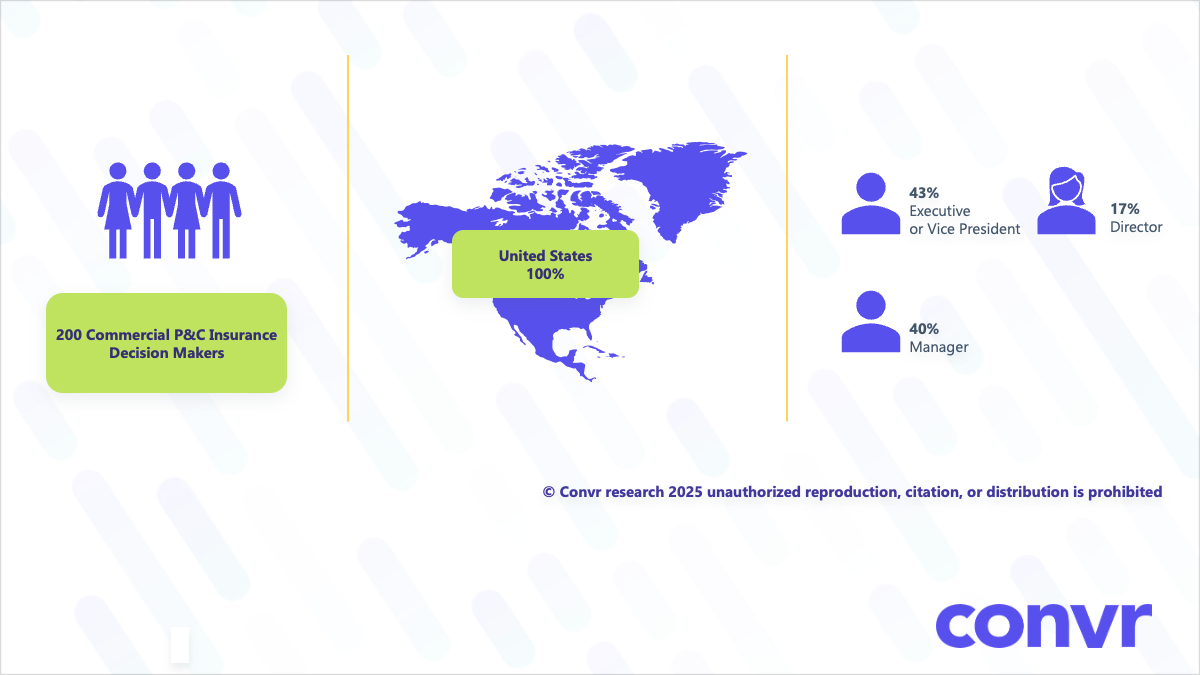
Case Study Demographics Survey

Executive Summary

Insights from Insurance Management on the Shifts Driving Underwriting Performance and Retention

The commercial property and casualty underwriting function is undergoing rapid transformation. As digital tools, automation, and AI reshape traditional processes, commercial property and casualty (P&C) insurance leaders are racing to modernize their teams and technology.

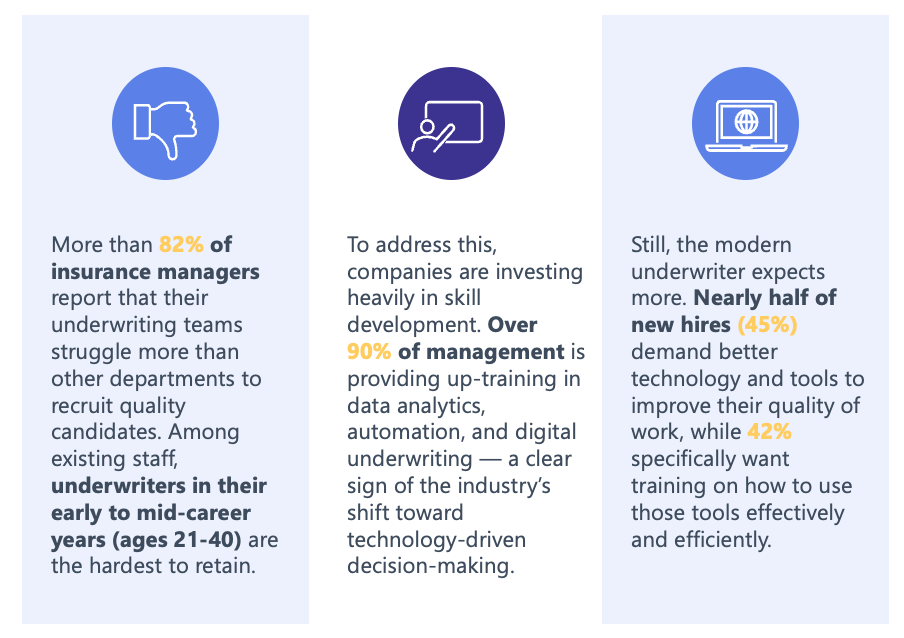
The recent 2025 Convr Insurance Talent and Tech Trends Survey reveals that more than 90% of insurance managers and above are actively up-training their underwriting teams in data analytics, automation, and digital underwriting. Yet despite these efforts, organizations still face significant talent and technology challenges that threaten efficiency, accuracy, and employee retention.

Key findings include:

  • Employee retention risk is highest among underwriters aged 21-40 - the very demographic positioned to lead the industry forward.
  • 45% of new underwriting hires request better access to technology and tools, and 42% want training on the latest systems.
  • 82% of managers believe their underwriting teams struggle more than other departments to attract quality talent.
  • 95% of leaders expect more underwriting tasks to be automated in the coming years, yet manual data entry remains the top barrier to speed and accuracy.

The message is clear: the next era of underwriting depends on smarter tools, simpler processes, and strategic investment in talent.

The Talent Challenge: Retaining and Reskilling the Next Generation

Insurance leaders overwhelmingly agree that underwriting talent can be challenging to find - and even harder to keep.​

Screenshot 2025-11-07 at 2.23.22 PM

The takeaway: attracting and retaining the next generation of underwriters requires a dual focus on career growth and technology empowerment.​

Technology Gaps Undermine Efficiency and Accuracy​

Understaffing and outdated technology are having measurable downstream effects on underwriting accuracy and customer experience.

  • 70% of managers believe that understaffing leads to inaccurate information in quotes.​
  • 82% believe understaffing directly harms customer experience.​
  • 56% cite manual data entry and collection as the number one issue slowing down underwriting operations.

In fact, managers ranked the top 10 causes of underwriting slowdowns as follows:​

Screenshot 2025-11-07 at 1.39.24 PM

The Automation Imperative

Nearly 95% of insurance leaders expect a higher percentage of underwriting tasks to be automated over the coming years. In fact, more than 80% believe that at least 25% of today's manual underwriting work could be automated.​

The potential gains are substantial. One Convr customer reported reducing quote turnaround time from 1-2 days to just nine minutes after implementing automated underwriting workflows - a testament to the power of automation and intelligent data ingestion.

For an industry still battling staffing shortages and data bottlenecks, automation represents not just efficiency - but sustainability.

Technology as a Retention Strategy

Better technology doesn't just improve productivity - it improves retention. 84% percent of insurance managers believe that upgraded tools and automation will probably or definitely reduce employee attrition.​ ​As one senior underwriting leader noted, "When we remove the repetitive, manual work underwriters can focus on what they actually trained for - risk assessment and decision-making."

Technology investments are already accelerating. 73% of companies delivered new underwriting tools to their teams in 2024, and 83% plan to deliver more in 2025.

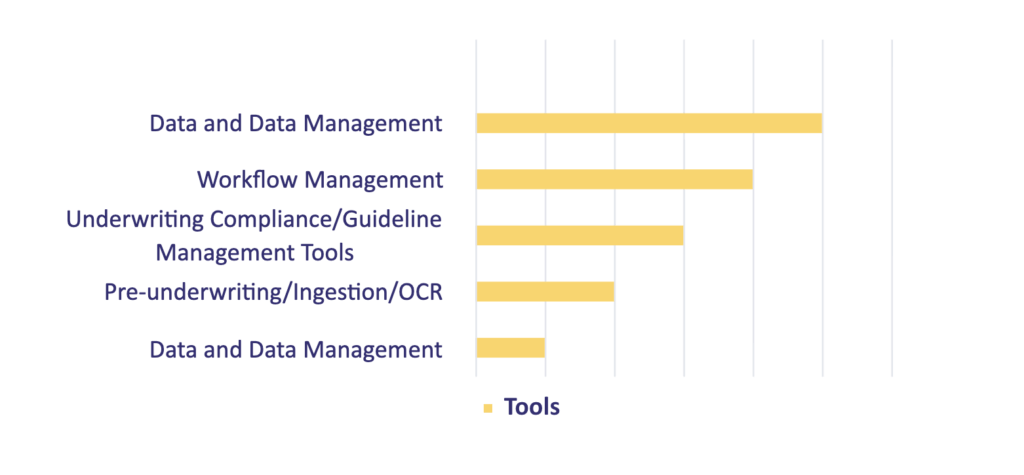
When asked which tools have the most impact, managers ranked the top five as:​

Screenshot 2025-11-07 at 1.47.12 PM

This hierarchy highlights a clear emphasis on data visibility, compliance, and automation - all key to modernizing underwriting at scale.

What Underwriters Need Most

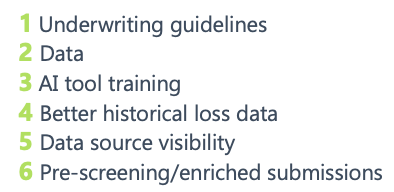
Respondents indicated that their underwriting teams would benefit most from simplified access to critical resources. In rank order, they cited:

Screenshot 2025-11-07 at 2.27.25 PM

Simplifying access to this information - and integrating it into daily workflows - is essential to improving accuracy, speed, and employee satisfaction.​

Top Skills for the Modern Underwriter

Even as automation grows, the human element of underwriting remains central. Commercial P&C insurance managers identified communication, detail orientation, and decision-making as the top three skills they seek in underwriting team hires.​ ​Even as automation grows, the human element of underwriting remains central. Commercial P&C insurance managers identified communication, detail orientation, and decision-making as the top three skills they seek in underwriting team hires.​ ​These "power skills" complement automation by ensuring underwriters can interpret, validate, and communicate insights from digital tools effectively.

A Vision for a Smarter, Faster Underwriting Future​

Nearly 95% of underwriting management agrees that their company's performance could improve through greater efficiency in underwriting processes. This consensus underscores a critical opportunity: to unite people, process, and technology in a cohesive digital strategy.

The path forward involves:

Automating routine work such as data collection, entry, and validation.​ Modernizing workflows through integrated data sources and workflow management systems.​ Training underwriters on AI tools and analytics to support faster, more accurate risk assessment.​ Improving data quality and accessibility to eliminate guess work and manual searches.​ ​Investing in experience - ensuring underwriters have tools that make their jobs easier, faster, and more rewarding.

Conclusion

The commercial P&C insurance underwriting profession stands at a turning point.​ ​While challenges in talent, staffing, and technology persist, the industry's direction is unmistakable: digital transformation is no longer optional - it's a competitive necessity.​ ​As automation expands and data becomes more central to decision-making, insurers that prioritize technology, training, and employee experience will not only operate more efficiently but also build the kind of workplaces that attract and retain top underwriting talent.​ ​The future of underwriting isn't about replacing human expertise -it's about amplifying it through technology.

Convr surveyed 200 commercial property and casualty (P&C) insurance decision-makers across the U.S. to dig into the role talent and technology play in driving results.

XX MIN READ

Modernizing Underwriting:Turning to Risk Scores

Modernizing Underwriting:

Turning to Scores

Risk Score bar chart

An Age-Old Problem

How do you select the right risk and price it appropriately? That's the goal of insurance underwriting. There is a delicate balance to charging acceptable rates and maintaining profitability. This is the domain of insurance underwriters who rely on historical data and actuarial analyses to evaluate and analyze the risks.

While the science behind it is valid, little has changed over the years in the way underwriting is performed by commercial insurance underwriters. Every day, thousands of these workers clock into their jobs with the intent to manage risk. They trudge through the mire of imperfect data, old policies, predictive analytics, online information and more to get to a place where they can comfortably accept, avoid or reduce the risk to their company. And why is it so hard? Because no single source is reliable, transparent, or comprehensive for assessing current or future risk.

The very essence of the underwriter's job is about making the best decision possible for their company, and they don't want to get it wrong. An inaccurate assessment of the risks associated with writing a policy or from insufficient premium could result in negative impact to loss and combined ratios. But, needless to say, sometimes they make mistakes.

As if this pressure is not enough, the sky-high pile of submissions and staffing shortages are among the many challenges these professionals face. Plus, there are dozens of cumbersome tasks and weeding through voluminous data sets and sources. Old underwriting tools require them to manually key in submission information from incoming documents. And then, the required quality checks contribute to longer lead times and added stress to maintain their high underwriting standards. The pace of work for today's underwriting professionals is accelerating and the pressure is only getting greater.

Now more than ever, the demand for faster submission processing and improved customer experience has carriers looking for ways to speed submission to quote. Insurance providers want straight through processing (STP) and their customers want real-time answers, quotes, and binders.

Happily, there are new solutions. Convr's Scores is one way underwriters are expediting their workflow, improving speed-to-quote and feeling assured their decisioning is sound.

Learn More

Machine Learning (ML) Modeling for Scoring Risks

Since 2019, Dr. John Henry, a consultant for Convr and the data science team have been forecasting risk related outcomes one year into the future. This might not seem like a big deal but since most commercial policies have a one-year duration or less, this is enough to provide underwriters with greatly increased confidence throughout the policy term. Examples of the events ML models are trained to forecast include injuries and fatalities.

The team trains the models on recurring schedules to include most recent data, consider new data sources, and improve performance over time. And the findings are presented in an easy-to-understand format - on a scale of zero to 100 called a risk score.

Convr's patented AI technology leverages ML models that are specifically trained for the commercial insurance industry. These models navigate structured and unstructured data from thousands of data sources and more than four billion data points to verify, cross-reference and deliver critical underwriting insights in real time.

Why Scoring Risks Works

Convr's risk scoring capability is driven by the need for accuracy and efficiency. Scores upgrade underwriter capabilities by providing the advanced data they need to make better and faster decisions. Convr's Scores deliver a single number measure of risk for businesses that an insurer can look to and quickly assess the relative risk of insuring a business and prioritize submissions. Companies that return a higher score would be more risky to insure while those with lower scores would likely present less risk.

Risk scoring brings more science and speed to the art of underwriting

For example, an underwriter can quickly see that a score of 90 means only 10% of businesses are more risky, while a score of 30 means 30% of businesses are less risky. The higher the score, the higher the risk. For an underwriter, it is as simple as filling in the name and address of a business and seeing real results that can affirm decisioning.

Risk Score slider

Scoring Simplified

Scores tell the underwriter where a business is on the risk distribution. A business with a score of 100 means it is in the riskiest 1% of businesses. A business with a score of 1 means that it is in the 1% of least risky businesses.

View Risk Score Sample

Convr's Data Science team found that underwriting profit in commercial auto had been trending down for several years at the time they began working on commercial auto models. His initial research looked at commercial auto loss experience at the industry level, and preliminary loss models were functions of (mostly) many geotemporal demographic and economic variables. Additional models were trained for commercial auto litigation verdict amounts, and large individual losses.

"Ultimately, we found that modeling accidents, injuries, and fatalities at the business level in a forward-looking way resulted in the most valuable predictive model(s) for underwriters. In the years since, these models have evolved and improved through collaborating with underwriters, actuaries, and claims professionals, and using more sophisticated methodologies."

Dr. John Henry

Consultant, Convr

Risk Score auto net performance

Source: Best's Market Segment Report; March 28, 2019

US Commercial Auto

Net Underwriting Performance

Today, Convr's commercial auto risk score modeling framework incorporates all these learnings, leverages Convr's massive data-lake that includes thousands of data sources - updated on a recurring schedule - always forecasting risk one year into the future. In 2022, Convr performed a retrospective study to validate how well our commercial auto risk scoring model was forecasting risk.

Accidents
Injuries
Fatalities

The Results

The results showed a convincing (and expected) relationship between Convr's Scores and injuries and fatalities per power unit. Businesses with higher scores experienced more of these events, on average, and businesses with lower scores experienced fewer of these events, on average. The study shows clearly that insurers with access to Convr's Scores in early 2021 would have been able to make decisions about current and potential insureds that would have resulted in better loss experience in the year ahead.

In the area of commercial auto for example, customers who were writing these policies have been avoiding the most risky insureds or those with the highest scores. They have been able to prioritize best risks (businesses with lowest scores). And they have been able to charge more (less) premium for insureds with higher (lower) scores.

See Real Results with

Scores and Risk 360 AI

Increase underwriting productivity

Prioritizing and reviewing submissions is often very manual and cumbersome. With d3 Risk Score, underwriters can rapidly narrow risks within their appetite and deep dive on selected risks via d3 Risk 360 (vs. Google search and DOT/Safer reports).

Reduce underwriting operating costs

Convr's implementations have seen a material reduction in operational cost across clearance, underwriting file preparation. Automation of these steps have helped our customers lower operational costs (FTE or BPO).

Increase speed to quote

A systematic approach, with d3 Score and d3 Risk 360 reduces administrative burden on Underwriters, reduces time to quote.

See growth of premiums

Increased underwriting productivity and speed-to-quote is expected to drive increased quote ratios, resulting in increased binds/new business.

Calibrate risk selection

Utilizing d3 Risk Score and d3 Risk 360, Underwriters can leverage relevant and timely information on insureds from Convr's data-lake of 2000+ data sources; high performing d3 Risk Score ML models further inform risk selection - this typically translates to better calibration of risk and greater consistency across the underwriting team.

Pricing adequacy

By monitoring loss performance with d3 Risk Scores, customers can identify segments of their book of business where they have an opportunity to adjust pricing to better reach their target loss ratio.

"The real opportunity is to look at your current book of business and incoming submissions and make better decisions today, tomorrow and going forward."

Dr. Addison Putnam

Consultant, Convr

Dive Deeper with Risk Relativity

Risk Score bar chart

workplace safety slider

Through risk relativity, underwriters can learn how the risk of a business compares to the average of the population through a score. One such score is specifically focused on workplace safety. For this model, we have found that some of the significant predictor variables for risk are previous infractions committed, type of permits assigned to a company and the number of years a company has been in business.

Why Scores, Why Convr?

To recap, achieving superior underwriting performance with Scores AI and Risk 360 AI can mean a commercial insurance underwriter can make more informed decisions, faster. In this way, insurance providers can realize transformative business growth and success. But, it is important to recognize that true transformation requires more than new technology. You need to be prepared for a shift in organizational mindset and culture, as well as the skill sets and roles of underwriters themselves. This is the secret to true competitive advantage.

As technology continues to transform the insurance industry, you can lead the revolution in your organization by reaching out to Convr. Convr's AI-infused commercial underwriting platform turbo-charges underwriting with more accurate and efficient decision-making and a greatly improved user experience.

At Convr, we are your partners in defining a new and better vision for commercial P&C insurance underwriting.

videos

Watch and Learn

XX MIN READ

AM Best TV interviewed Convr CEO John Stammen

AM Best TV interviewed Convr CEO John Stammen at National Association of Mutual Insurance Companies (NAMIC) in September 2024. He shared insights on the value of AI underwriting and operations and how Convr AI can streamline submission to quote by reducing data entry, research and aggregation tasks to provide a better customer experience. Take a listen and hear how agents and others are winning new business with Convr AI.

XX MIN READ

Convr Data Science

\n

With a rich underlying data lake, time-tested data pipeline with data orchestration, and data currency with pre-plumbed, continuous updates, Convr AI sits on a rock-solid foundation that is unrivaled in the commercial insurance space. AI is integrated into everything we do. It informs our customers' submission selection and prioritization, risk quantification, and relativity assessments leading to improved decision-making. Explore even more at convr.com.

\n

XX MIN READ

Evaluating the Relative Quality of a Risk with Scores

Realize End-to-End Underwriting Excellence with Convr AI

Experience how commercial P&C insurance organizations benefit from submission through quote with a frictionless process enriched by AI decisioning, empowering them to make better decisions, faster.