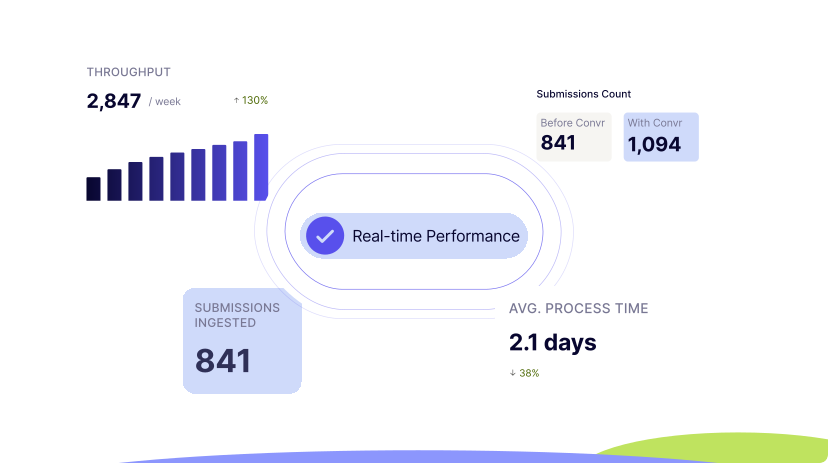
Improve Operational Efficiency

Process more submissions without adding headcount.

Proven Impact

How Insurance Operations Teams Improve Efficiency With Automation

Convr delivers measurable improvements across efficiency, speed, and underwriting performance.

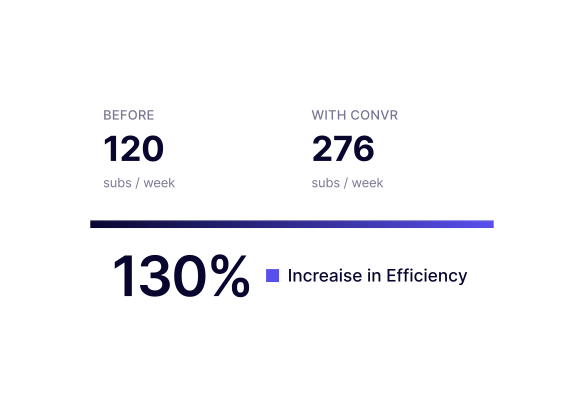
130% Increase in Operational Efficiency

Automate manual processes and enable teams to process significantly more submissions with the same resources.

15% Higher Win Rate

Respond faster and prioritize the right risks to improve conversion and drive premium growth.

Operations Leaders Get

Get Immediate Performance Visibility with Historical Data Repository

Team-level throughput visibility

Track underwriter throughput, decision velocity, and submission-to-quote ratios across your entire team. Identify who needs support and who's ready for more responsibility.

SLA monitoring and alerts

Set thresholds for processing time, quote turnaround, and bind cycle. Convr flags submissions at risk of breaching SLA before they actually do.

Carrier-ready performance reporting

Live program performance dashboards your carrier partners can review on demand — proving disciplined underwriting without quarterly reporting overhead.

Operational Excellence

Improve operational efficiency without adding headcount.

Human + AI Collaboration

AI with Human-in-the-loop (HITL) scales, improves productivity, and governance.

Expert Review

Underwriters Stay in Control

Convr AI ingests and structures submission data, while underwriters review, validate, or adjust key fields – ensuring accuracy before information moves into downstream systems.

Learning System

Smarter with Every Interaction

User feedback and corrections help refine AI outputs over time, improving data quality, extraction accuracy, and overall underwriting efficiency.

Resources

Dive Deeper into Convr

Access thought leadership, industry insights, and practical resources to modernize underwriting and drive better outcomes.

Blog

The Hidden Cost of Manual Data Entry in Commercial Lines Underwriting

Ask a commercial lines insurance underwriting leader where their team's time goes, and the honest answer often isn't underwriting at all. It's data entry: keying in values from an SOV, cross-referencing a loss run against a submission, retyping limits and named insureds from a PDF into a rating system.

On paper, this looks like a minor operational cost, the price of doing business with documents that don't come in clean formats.  

The visible cost of manual data entry is time. A commercial property submission with a large SOV can take an underwriter or their support staff hours to process by hand, checking property values, occupancy types, and construction details against what's on the application. Multiply that across a full pipeline of submissions, and the hours add up fast.

While time is the cost that's easiest to see, it is often the least significant one. The hidden costs are the ones that don't show up until later.

‍The following are four hidden costs underwriting leaders need to consider:


Cost one: decision quality

Every hour an underwriter spends transcribing data is an hour not spent evaluating it. When manual entry eats into the day, the analysis that should happen around a submission -- spotting a concerning trend in loss history, questioning whether a stated property value is realistic, comparing an account against appetite -- gets compressed into whatever time is left.

Underwriting quality doesn't erode all at once. It erodes in small increments, submission by submission, as the ratio of time spent on data handling to time spent on judgment tips further out of balance. See why this is a hidden cost that cannot be overlooked?

Cost two: accuracy risk

Manual entry is also where errors creep in. A transposed limit, a missed COPE field, an incorrectly keyed TIV, these mistakes are easy to make and hard to catch, especially under volume pressure.

In commercial lines, where pricing and terms often hinge on the accuracy of property and exposure data, a small entry error can compound into a meaningfully mispriced risk. The cost of that error rarely surfaces immediately. It surfaces later, at claim time or renewal, when it's far more expensive to fix.

Cost three: inconsistent turnaround time

Manual processes don't scale evenly. When submission volume spikes, whether from a hard market, a new distribution partnership, or seasonal patterns, teams reliant on manual data entry hit a ceiling fast. Turnaround times stretch, brokers wait longer for quotes, and the accounts that move fastest aren't necessarily the best risks. In fact they're often the ones with the simplest paperwork. That's not a formula for disciplined underwriting; it's a formula for favoring ease over quality.  

Cost four: talent and turnover

There's also a cost that's harder to quantify but increasingly difficult to ignore: the toll manual entry takes on the people who are doing it.

Underwriters and underwriting assistants who spend a disproportionate share of their day on repetitive transcription rather than analysis tend to disengage from work that should be intellectually demanding. In a competitive labor market for underwriting talent, that's a retention risk hiding in plain sight.

Why this is solvable now

None of this is a new problem. What's changed is the availability of tools built specifically to solve it. Convr’s structured data ingestion, purpose-built for the ACORD forms, SOVs, and loss runs that make up commercial submissions, can take on the transcription work directly, pulling and validating data with a level of consistency manual entry can't match.

That data then feeds the Risk Context Engine, Convr’s ontology for commercial P&C risk, so a submission doesn’t sit as an orphaned record, it’s tied to the broader risk picture connected to prior submissions, relationships, and appetite history rather than evaluated on its own. That doesn't remove underwriters from the process. It removes the bottleneck standing between a submission arriving and a qualified underwriter evaluating it.

Rethinking where the real cost sits

The instinct to treat manual data entry as an operational cost is understandable.

It doesn't show up as a line item the way software or headcount does. But its true cost is distributed across decision quality, accuracy, turnaround times, and talent retention, all of which matter far more to a commercial lines book than the hours spent on submission entry alone.

The teams that recognize this are the ones rethinking where their underwriters' time really belongs, and building workflows that let judgment, not transcription, define how a submission gets handled.

If you’re ready for a conversation about re-envisioning how your team can improve the underwriting experience while avoiding some of these time sucking hidden costs, visit convr.com and book a demo today.


‍

Blog

Convr Prioritizes Communication in Underwriting Workbench

Email

Convr is making it easier than ever to communicate about submissions within the Convr AI Underwriting Workbench. Now there is an email capability where Convr customers can create new messages for submissions. A user would first need to have a specific submission open within the platform to see the email functionality available to them.

Within the left-hand pane they would just need to click, “Email” then “Create New Message.”

From there the “From” section will automatically be generated with their user email and they would need to plug in a recipient email address. The subject line would also be prepopulated with the submission name.

Convr users can also upload submissions assets and additional attachments about the submission in addition to crafting a customized message about the submission.

Comments
Within the Summary screen you can now also add a “Comment” about a submission, and they can be posted anywhere into Forms, Assets, Emails, etc. to support collaboration. Additionally, you can build a thread of comments. You can also reply to your own comment or react to another user’s comment with a thumbs up, as well.

The idea is that you’re creating a record or recorded conversation allowing another user to enter the platform, to get up to speed on the submission chat and join the conversation with the addition of new comments, which will show up within the feed as well.

You can tag users too, so they receive an in-app notification and email. You can also see in-app alerts, click on them and be taken directly to where you as a user were mentioned within the submission. This global, in-app notification feature is useful if a user wants to bring a team member’s attention to a given item within a submission.


The intent is to open lines of communication between underwriting team members to ensure there is greater transparency and oversight of submissions.

Convr is invested in improving the Convr AI Underwriting Workbench user interface for customers and believes these two new communication features will enhance collaboration and visibility throughout the submission process.  
 

To learn more about Emails and Comments capabilities reach out to Convr at convr.com to book a demo.

‍

News

Convr® Launches DocData, Propelling Submission Excellence and Intelligence for Carriers, MGAs, and Brokers

CHICAGO (September 8, 2026) – Convr®, the leading artificial intelligence company serving commercial insurance organizations, has introduced DocData for commercial brokers, carriers, and MGAs to submit their insurance application documents and receive a comprehensive risk summary for each submission in minutes.

DocData summarizes operational characteristics, exposures, loss history, and other essential data from original submission documents, providing organizations with a reliable overview that lets them know of the risk.

"Carriers,MGAs, and brokers share the same interest in perfecting application data whilereducing handling time,” said Harish Neelmana, Founder, President and ChiefProduct Officer at Convr. “Now they can feed submission documents to Convr and geta comprehensive review of the risk in just minutes.”

First-time users receive five submissions at nocost within five days. Users who see value in expanding to higher volumes can upgradeto the full Convr AI Underwriting Workbench with confidence in the returns theywill see.

Media Contact
Alex Williams
Senior Promotions Manager
alex.williams@convr.com

‍

Frequently Asked Questions

Find quick answers to common questions about our platform, capabilities, and implementation.

How much manual work can be automated?

Convr automates a significant portion of operational work by digitizing submissions, eliminating duplicate data entry, pre‑filling forms, routing work automatically, and applying fitness and clearance rules. Manual intervention is reserved for exceptions through Human‑in‑the‑Loop (HITL) review, reducing overall operational effort while maintaining control.

How will Convr improve processing speed?

By automating ingestion, enrichment, prioritization, and workflow routing, Convr accelerates submission processing and reduces cycle time across intake, clearance, and underwriting preparation. Real‑time data enrichment and integrated workflows allow teams to move submissions forward without waiting on manual handoffs.

Can we handle more submissions without adding headcount?

Convr is designed to increase throughput without linear increases in staffing by enabling straight‑through processing for high‑confidence submissions and focusing human effort only where review is required.

Can Convr help standardize workflows across teams?

Convr provides configurable, standardized workflow stages, labels, and routing rules that can be applied consistently across teams, lines of business, and geographies. This ensures repeatable processing, clearer handoffs, and reduced variability in how submissions are handled.

How can insurers scale underwriting without hiring more staff?

Convr removes the manual work that limits underwriting capacity. By automating submission intake, data extraction, triage, and enrichment, it delivers complete, decision-ready risks to underwriters, so they can focus only on evaluating.

Modernize Your Underwriting Workflow

Automate submission intake, accelerate triage, and empower underwriters with actionable risk insights