



Commercial P&C insurers win on a simple equation: selecting risks whose premium and terms adequately cover expected losses, expenses, and capital costs, while staying competitive enough to bind. The hard part is that “good” risks rarely arrive in a neat, comparable form. Submissions come with inconsistent data, missing attachments, ambiguous class codes, and unstructured loss runs. Meanwhile, market cycles compress timelines. Brokers expect fast answers, underwriters face submission volumes that outpace capacity, and small delays can mean losing a desirable account to a competitor.
Identifying profitable risks faster is not just about quoting quickly. It is about making earlier, higher quality decisions with less rework. That requires an operating model that can separate high potential submissions from low fit ones within minutes, route the rest to the right expertise, and ensure pricing and coverage decisions remain governed and consistent. Speed without discipline can deteriorate results through adverse selection, misclassification, and leakage in terms and conditions.
The insurers that consistently improve new business performance typically do three things well. They build a triage pipeline that standardizes intake and enriches data early. They translate that data into consistent classification and risk signals that guide selection and pricing. And they maintain feedback loops at renewal so portfolio learnings continuously sharpen future decisions. The goal is a repeatable system where underwriting judgment is amplified, not replaced, by data and automation.
Defining “Profitable Risk” in Commercial P&C and the Constraints Insurers Face
A profitable commercial P&C risk is one that performs acceptably across time, not just at bind. Profitability is usually measured at the account and portfolio levels as underwriting profit, combined ratio, and risk-adjusted return on capital. At the individual risk level, “profitable” often means the expected loss cost plus expenses plus capital load is meaningfully below the expected premium net of commissions, while also fitting appetite and operational constraints.
The problem is that profitability is conditional. The same business may be profitable or unprofitable depending on location characteristics, construction details, safety programs, fleet composition, contract terms, limits, deductibles, and attachment points. Profitability also depends on the insurer’s portfolio concentration and reinsurance structure. A risk that looks attractive in isolation may be unattractive if it increases aggregation in a peril, industry, or corridor where the insurer is already heavy.
Insurers face constraints that make “fast and profitable” difficult. Submission quality is uneven, and the earliest data is often the noisiest. Underwriters have limited time to hunt for missing facts, yet the cost of a wrong decision is high. Regulations and internal governance require consistent documentation, fair and explainable decisioning, and adherence to filed rules where applicable. Distribution dynamics add pressure: brokers expect rapid indications, but will not tolerate frequent reversals after deeper review.
Then there is the reality of long-tail lines and delayed loss emergence. A book that appears profitable on new business can deteriorate over time if risk characteristics drift, pricing erodes, or claims inflate. That is why “profitable risk identification” must include a view of sustainability: stable operations, clear controls, consistent exposure bases, and transparency in financial and loss information.
In practice, profitable risk selection is less about a single perfect model and more about managing uncertainty. High-performing insurers reduce uncertainty early by standardizing intake, enriching submissions with third-party and internal data, and applying consistent classification and risk scoring. They also design workflows that match effort to opportunity, so that deep underwriting time is reserved for the submissions most likely to bind profitably.
Building a Fast Triage Pipeline: Data Sources, Submission Quality, and Intake Automation
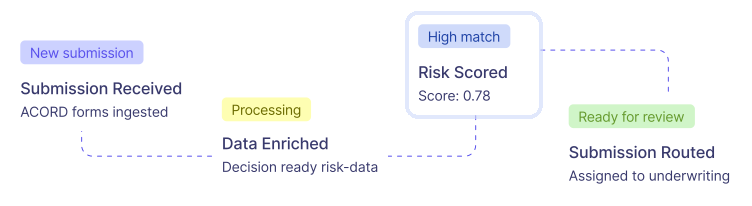
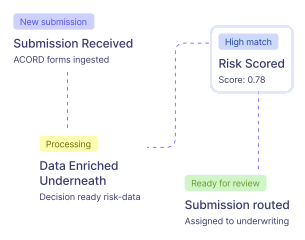
Fast profitable decisions begin before underwriting touches the file. The first objective is triage: quickly determine whether a submission is in appetite, whether it is complete enough to assess, and what level of underwriting attention it deserves. This requires a pipeline that can ingest documents and data in many formats, extract key fields, validate them, and enrich them with external and internal sources.
A practical triage pipeline starts with intake automation. Submissions arrive as emails, ACORD forms, PDFs, spreadsheets, supplemental applications, loss runs, and schedules. Intelligent document processing can extract essentials such as named insured, operations description, locations, payroll and sales, vehicle counts, construction details, and prior carrier information. The key is not extraction alone but normalization. “Sales” may appear as revenue, gross receipts, or turnover, and the system must standardize definitions and units.
Next comes submission quality scoring. This is a simple but powerful mechanism: grade completeness, internal consistency, and credibility. Are class descriptions aligned with exposure bases? Do payroll totals reconcile across locations? Are loss runs current and covering the requested term? Are critical attachments present, such as supplemental questionnaires or safety program documentation? A quality score supports two outcomes: faster declines for unworkable submissions and targeted “missing info” requests that reduce back-and-forth.
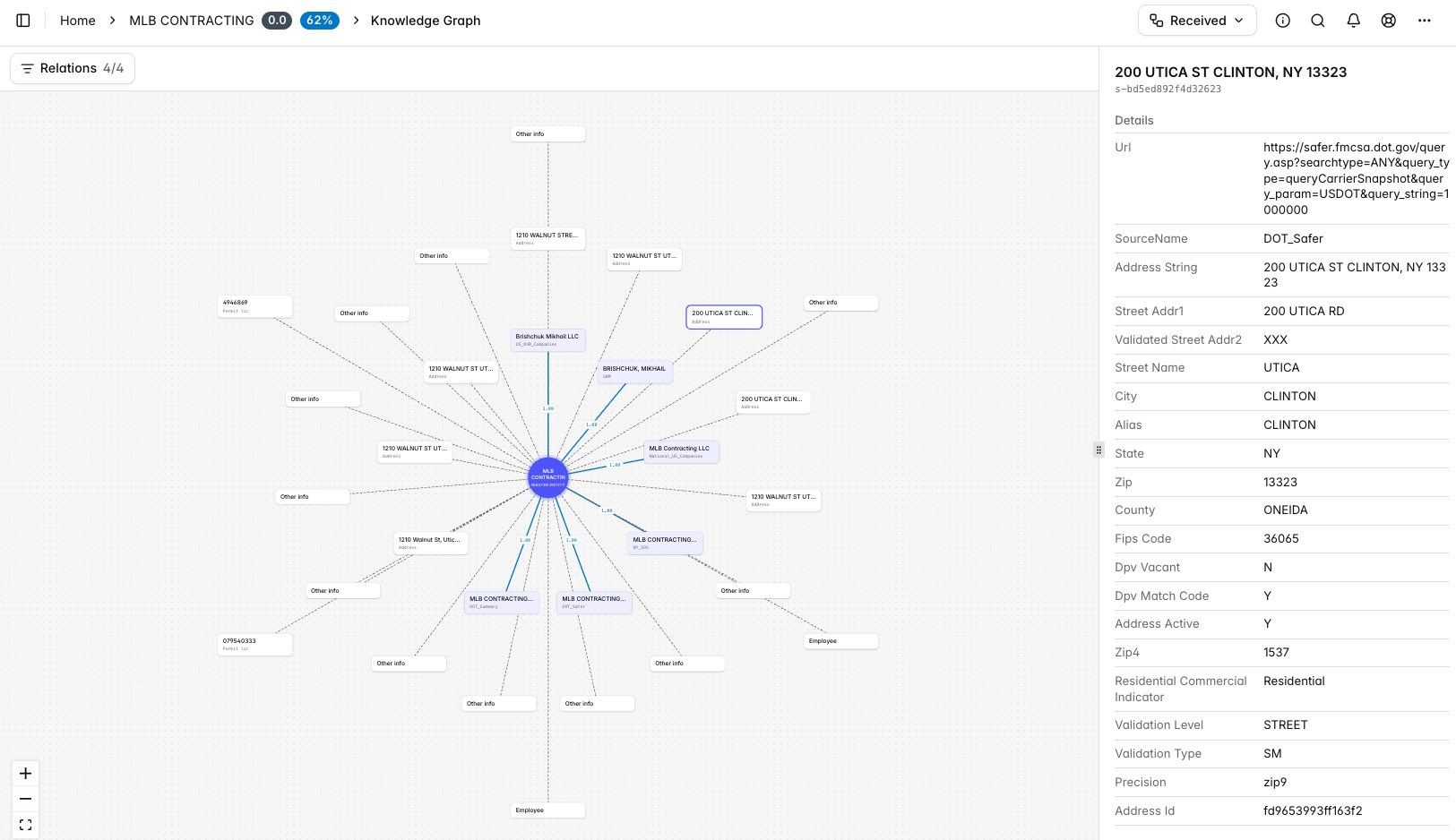
Enrichment is the third leg. External data can validate and enhance what is submitted, for example business registration data, industry classification, web signals, property characteristics, geocoding, catastrophe and crime scores, lien information, and inspection history where available. Internal data, such as prior submissions, historical quotes, claims experience, and broker performance, can also add context. The goal is to transform a sparse submission into a decision-ready record.
Finally, the triage pipeline should route work intelligently. Straightforward, high fit submissions can move toward quick indication or automated referral rules. Complex risks can be directed to the right underwriter based on industry expertise, line complexity, and authority. Risks with red flags can be queued for specialist review. This routing reduces cycle time by preventing misassignment and by ensuring senior underwriters spend time where it creates the most value.
Done well, triage is not a gate that slows business. It is a filter and accelerator that improves speed, reduces rework, and protects underwriting capacity for the best opportunities.
Risk Selection at Speed: Classification, Scoring, and Pricing Governance
Once a submission is decision-ready, the next challenge is making a selection and pricing decision quickly without sacrificing governance. The foundation is consistent classification. Commercial accounts are frequently misclassified because operations are described in narrative form, class codes differ by line, and businesses change over time. Misclassification leads to wrong loss costs, wrong underwriting rules, and inconsistent appetite decisions. A robust approach uses a commercial insurance ontology, mapping business descriptions, NAICS or other industry labels, and underwriting classes into a harmonized view. This supports faster, more consistent risk segmentation and better downstream pricing.
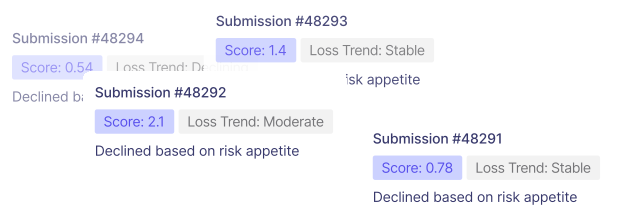
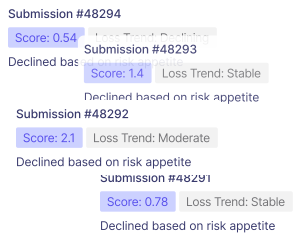
Risk scoring then translates data into actionable signals. Not all scores are predictive, and not all are useful. The best scores are tied to clear decisions: appetite fit, expected loss ratio range, volatility, hazard indicators, and likelihood of underwriting actions such as requiring a protective safeguard or imposing a higher deductible. Scores should be explainable to underwriters and auditable for governance. A score that cannot be interpreted will either be ignored or misused.
Speed also depends on effective pricing governance. Underwriters need freedom to compete, but within guardrails that protect margin. Guardrails include minimum rate adequacy by segment, referral triggers for large credits or unusual terms, and consistent handling of exposure changes. A practical method is to embed “pricing reason codes” in the workflow, such as credit for strong safety program, debit for adverse loss frequency, or adjustment for unusual contractual risk transfer. This creates documentation discipline and a dataset for later portfolio learning.
Another lever is decision tiering. Many submissions do not require the same level of scrutiny. Small, standard risks with strong data can follow a low-touch path with automated checks and quick underwriter confirmation. Mid-market risks can use structured underwriting templates and guided questions driven by the ontology and risk signals. Complex risks can trigger deeper review, loss control consultation, or specialized modeling. The insurer still underwrites all risks, but not all risks consume the same time.
Speed must also be paired with consistency in coverage and terms. Leakage often occurs through manuscript endorsements, inconsistent additional insured language, or lax application of exclusions. A guided system can recommend standard forms based on operations and highlight common gaps between requested and acceptable terms. Underwriters can deviate, but deviations become visible and reviewable.
When classification, scoring, and governance work together, underwriters spend less time assembling facts and more time applying judgment. The result is faster decisions that are also more repeatable, defensible, and profitable.
Monitoring for Renewal Profitability: Material Change Detection and Portfolio Feedback Loops
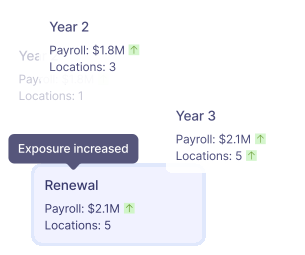
Profitability is not locked in at bind. Commercial insureds change: payroll grows, operations expand, subcontracting increases, new locations open, fleets change, and contracts evolve. Some changes increase exposure in predictable ways, while others fundamentally alter the risk profile. Renewal is where insurers can protect profitability by detecting material changes early and adjusting pricing, terms, or appetite decisions accordingly.
Material change detection starts with comparing current period data to prior period baselines. The baseline includes exposure measures, class mix, locations, and loss experience. Changes can be identified through updated applications, audits, endorsements, and claims, but also through external data signals. For example, a business website that suddenly advertises new services may indicate an operations shift. A new address may indicate a new location with different hazard characteristics. Filings or public data may reveal ownership changes or rapid growth. The point is not to surveil but to reduce surprises.
A structured renewal workflow flags changes that matter. Not every delta is material. The workflow should focus on changes that have a meaningful impact on expected loss or volatility, such as higher hazard operations, significant payroll or sales growth, new subcontracting practices, new vehicle types, or worsening loss frequency. These flags can drive targeted questions to the broker and insured, reducing renewal friction while ensuring the underwriter gets the right information.
Portfolio feedback loops then convert renewal outcomes into better new business decisions. This includes tracking how early-stage scores and classifications correlate with later loss results, retention, premium adequacy, and claim severity. If a segment consistently deteriorates after renewal due to exposure drift, the appetite or pricing assumptions should be updated. If certain brokers deliver better data quality and better-performing business, distribution strategy and triage prioritization can reflect that. If particular endorsements or terms correlate with unexpected losses, coverage governance can be tightened.
Operationally, feedback loops require clean data capture. Renewal underwriters need to record the reason for key decisions: why a rate change occurred, why terms changed, why an account was non-renewed. Claims and underwriting data need a shared vocabulary so patterns can be detected. Without structured decision data, portfolio learning becomes anecdotal and slow.
When renewal monitoring and feedback loops are mature, insurers improve profitability in two ways. They reduce leakage by catching exposure changes before they become underpriced. And they improve future speed by refining triage and scoring so the best risks are identified earlier with higher confidence.
FAQs
How do insurers define “in appetite” quickly without oversimplifying the risk?
Most insurers begin with a high-level appetite statement, but speed comes from translating that statement into operational rules tied to data fields. “In appetite” becomes a set of checks across industry classification, revenue or payroll thresholds, location and occupancy characteristics, loss history, and required controls. To avoid oversimplification, the rules should include referral bands rather than binary accept or decline. For example, a class might be acceptable generally, but referrals trigger when certain operations are present or when loss frequency exceeds a threshold. The fastest systems also use structured extraction from submissions so these checks run immediately, and they attach an explanation to each outcome so underwriters and brokers understand what drove the result.
What data matters most for faster profitable risk selection in commercial P&C?
The most valuable data is the data that reduces uncertainty early. That usually includes a clear description of operations, accurate exposure bases by class, complete location and schedule information, current loss runs with meaningful narratives, and prior carrier and pricing context. Beyond submission data, enrichment that validates the business and clarifies hazards often has outsized impact, such as industry classification alignment, geocoding for hazard context, property characteristics for building-related lines, and indicators of operational complexity like subcontracting reliance. Insurers also benefit from internal performance data: how similar accounts performed in loss ratio, what terms were applied, and what pricing actions were required at renewal. The key is not collecting everything, but prioritizing the minimum dataset that enables confident selection and appropriate terms.
How can automation speed underwriting without causing adverse selection?
Automation reduces adverse selection when it improves consistency and frees underwriters to focus on judgment-heavy decisions. The safer pattern is “automation with guardrails.” Use automation to extract and validate data, score submission quality, detect inconsistencies, and surface risk signals. Then apply governed rules for appetite and pricing thresholds, with clear referral triggers. Adverse selection risk rises when automation is used to auto-quote broadly without strong data validation or when models are treated as truth rather than decision support. It also rises if speed incentives cause underwriters to skip documentation or accept weak data. A balanced approach measures not only quote speed, but also bind quality indicators such as data completeness at bind, exception rates, and early claims emergence.
What is a commercial insurance ontology and why does it matter for speed?
A commercial insurance ontology is a structured framework that connects business concepts insurers care about, such as operations, hazards, classes, exposures, coverage needs, and underwriting rules. It matters because commercial submissions are messy and inconsistent. Two brokers may describe the same business in different words, and different lines may use different class systems. An ontology helps normalize those descriptions into a consistent classification and set of attributes. That consistency is what enables faster triage, better routing, reliable analytics, and more consistent pricing and coverage decisions. It also improves explainability: underwriters can see why a business was classified a certain way and what hazards or rules are associated with that classification, making decisions quicker and more defensible.
How do insurers detect material change at renewal without creating extra work for brokers?
The best renewal processes start by reusing what the insurer already knows and focusing outreach only where change is likely and meaningful. Material change detection compares current signals to prior period baselines and flags only the deltas that matter, such as significant exposure growth, class mix shifts, new locations, or adverse loss trends. Instead of sending long supplemental applications to every account, the insurer can generate targeted questions tied to the flagged change. Brokers experience this as fewer, more relevant requests. Internally, underwriters save time because they are not re-collecting stable data each year. The process works best when renewal data is structured and when prior-year exposures, terms, and decision notes are easy to access and compare.
Conclusion
Commercial insurers identify profitable risks faster when they treat speed as a system design problem, not an individual underwriter heroics problem. Profitability depends on selecting risks that fit appetite, are priced with adequate margin for their expected loss and volatility, and remain stable or at least transparent as they evolve. The constraints are real: inconsistent submissions, limited underwriting capacity, broker time pressure, governance requirements, and the long-tail nature of many commercial lines.
A high-performing approach starts with a fast triage pipeline that automates intake, extracts and normalizes data, scores submission quality, enriches key attributes, and routes work to the right expertise. It continues with consistent classification and risk scoring that translate messy information into governed decisions, supported by pricing guardrails and clear documentation. And it extends through renewal with material change detection and portfolio feedback loops that sharpen future appetite, pricing, and workflow choices.
Insurers that build these capabilities can reduce cycle time while improving decision quality, because underwriters spend less time chasing missing facts and more time applying judgment to well-structured information. To learn more about modern underwriting workbenches and how they support faster, governed decisions, visit https://convr.com/.