Commercial Underwriting Workbench Powered by AI

The Convr AI Underwriting Workbench automates submission intake, enriches risk data, and prioritizes underwriting decisions across the full submission-to-quote lifecycle.

Data, Discovery, Decision

The Convr AI Underwriting Workbench

Convr helps insurers automate submission intake, structure data, and generate underwriting insights using AI.

End-to-end underwriting intelligence

Modular Solutions Enabling Quicker Time-to-Value

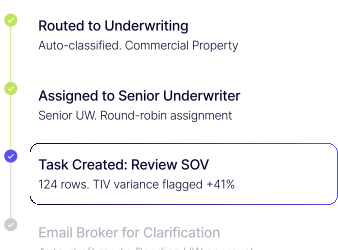
Convr ingests structured and unstructured submissions, classifying, enriching, and standardizing submissions automatically clearing, triaging and prioritizing within appetite in minutes.

01

Submission Pre-fill, Triage & Clearance

Convr ingests structured and unstructured submissions, classifying, enriching, and standardizing submissions – automatically clearing, triaging and prioritizing within appetite in minutes.

02

Submission Prioritization & Risk Selection

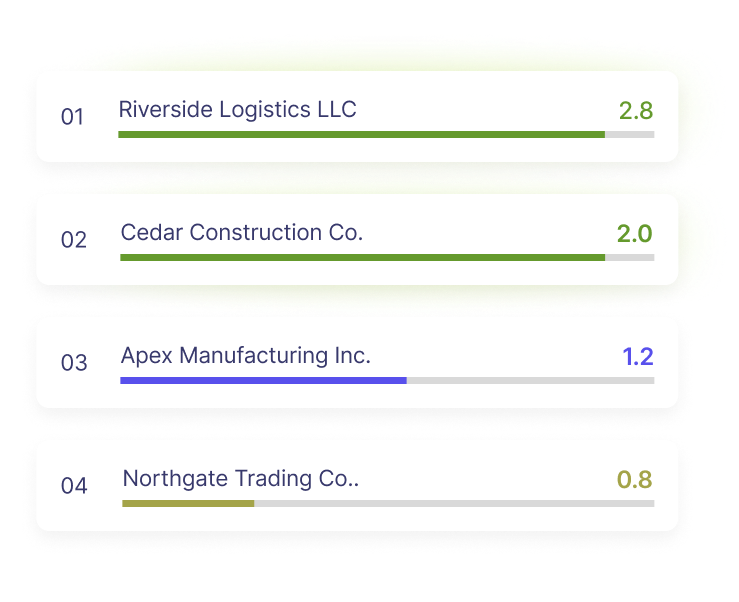
Convr scores every submission on appetite fit and data completeness – surfacing priority submissions first, allowing underwriters to focus their time on the right risks to rate, quote, bind faster, smarter.

03

Risk and Portfolio Insights

Convr's portfolio dashboards support pricing audits, underwriting governance, and performance monitoring across every segment and line – giving visibility to the full lifecycle of the risk.

04

Rate, Quote, Bind Workflow Automation

Convr orchestrates data, logic, and action with lineage in one connected view — providing trusted and verified risk insights, automating rate-to-bind workflows improving underwriting productivity with greater speed and confidence.

05

Pre & Post-bind Classification and Exposure Analysis

Convr verifies insured business identity and exposures at every stage — pre- and post-bind — to support price adequacy, loss avoidance, and a clean, structured view of underwriting opportunity and/or portfolio risk.

06

Renewal Material Change Analysis

Convr identifies material changes across the full policy lifecycle – detecting shifts in exposure, payroll, locations, risk profile, and more between periods so underwriters can proactively take action. 

The Convr AI Underwriting Workbench

Every Tool Your Underwriting Team Needs

Convr's modular workbench covers the full submission lifecycle from intake and enrichment to scoring, decisioning, and portfolio analysis, so underwriters work faster, smarter, and with more confidence at every step.

Intake

From Chaos to Structured Data in seconds to minutes

Risk 360

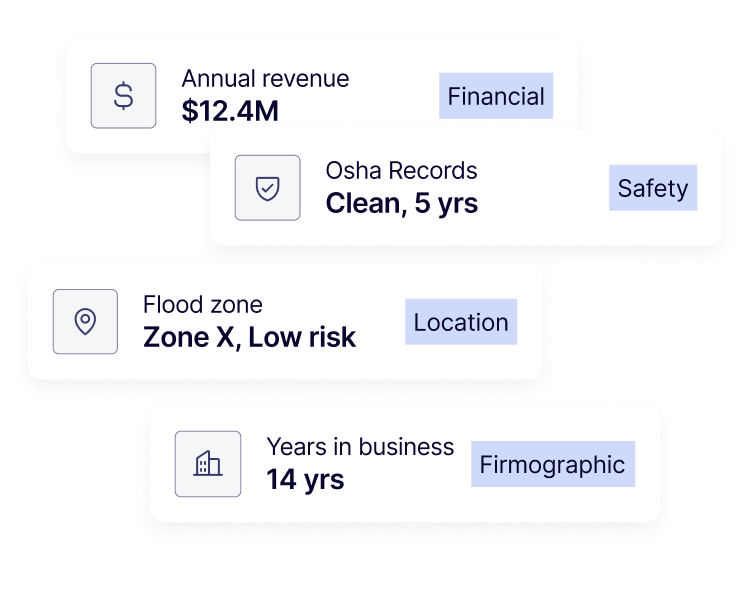
A Complete Picture  of Every Risk

Answers

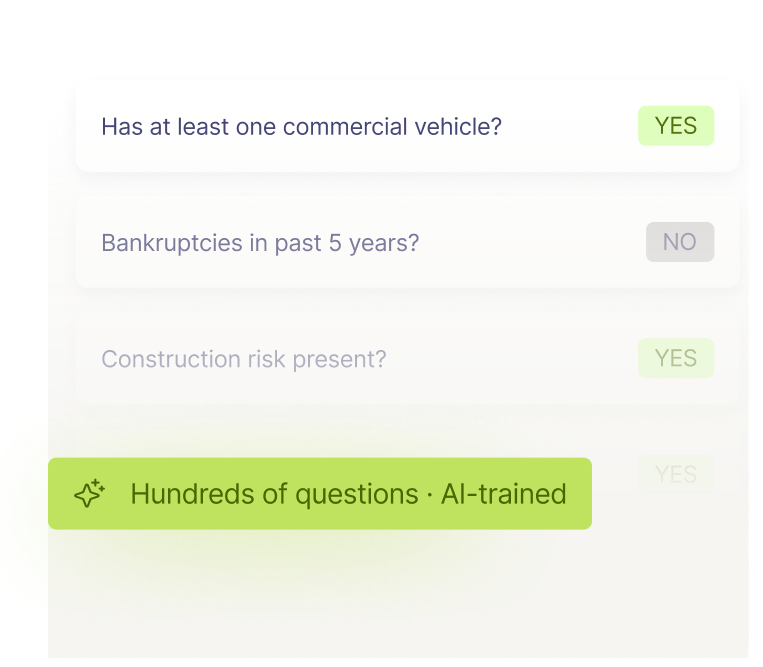
Get the Right Information Instantly

Scores

Know Which Risks Are Worth Your Time

Insights

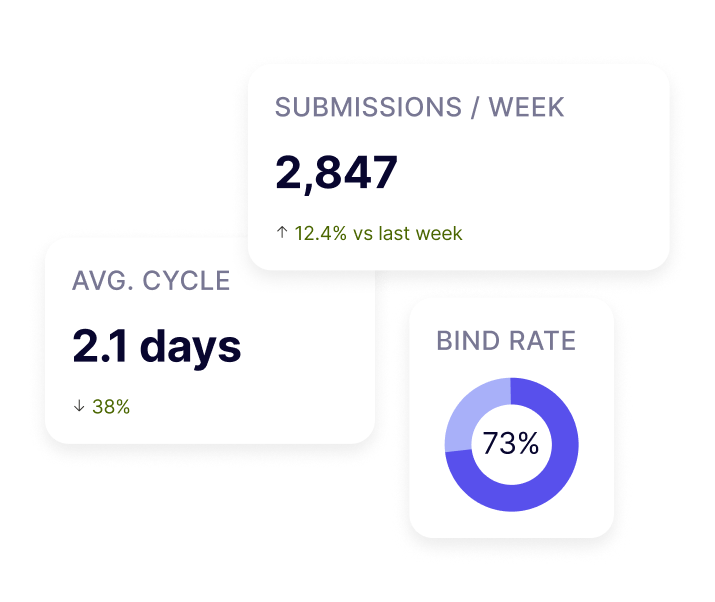
Portfolio and Operational Intelligence

workflow

Streamline Collaboration and Move Submissions Forward Faster

D3 desk

Rate. Quote. Bind.

COnvr AI

Improve Productivity with Speed and Confidence

See the Convr ROI Potential

Estimate the operational and underwriting impact of Convr in minutes.
OUR PROCESS

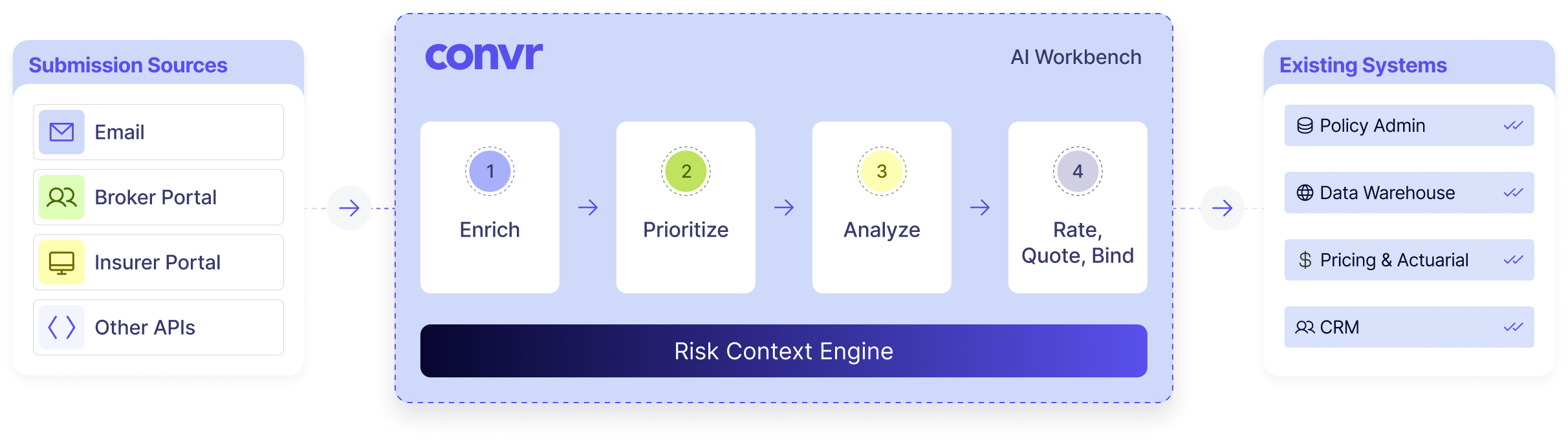
End-to-end AI-Powered Underwriting

A comprehensive, end-to-end solution purpose-built for commercial P&C insurance.​

Built to Fit Your Stack

Built to Work Within Your
Existing Insurance Ecosystem

Convr APIs Integrate Seamlessly.

API-First Integration

Connect Convr to your existing policy admin systems, rating engines, and internal tools without ripping and replacing your current infrastructure, enabling seamless data exchange across the underwriting workflow.

Structured Data for System Interoperability

Every submission is standardized into a consistent, structured format – so your downstream systems can consume, process, and act on it immediately, without manual reformatting.

Resources

Dive Deeper into Convr

Access thought leadership, industry insights, and practical resources to modernize underwriting and drive better outcomes.

Blog

The Convr Risk Context Engine: Why it Matters to the Chief Underwriting Officer

The problem every Chief Underwriting Officer (CUO) faces isn't a shortage of AI tools. It's a shortage of AI they can trust and embed seamlessly within their workflow.

Generative models, agentic assistants, and large language models have proliferated across the insurance industry at an unprecedented pace. Nearly all of them share the same critical flaw: they’re built on general-purpose foundation models that were never trained on commercial insurance and have never seen a real submission, a real loss run, or a real underwriter's decision. They can produce fluent text about underwriting without understanding it. For a CUO responsible for combined ratios, regulatory defensibility, and the consistency of thousands of risk decisions per year, that gap is a material liability.

The Convr Risk Context Engine (RCE) is the answer to that problem and it’s the only answer of its kind.

What makes the RCE unique

Unveiled on June 9, 2026, the RCE is a commercial P&C knowledge graph and semantic ontology that encodes the language, structures, exposures, classifications, and decision logic of underwriting into a unified, machine-readable model, calibrated against a decade of real submissions, real exposures, and real underwriter feedback from leading carriers in production.

The practical implication of that architecture is profound. The RCE does not approximate what a painting contractor is; it knows the difference between a painting contractor and a roofing contractor at the classification level and it knows how that difference should affect appetite, coverage, and pricing. It understands that "general liability for a habitational account in coastal Florida" carries a specific set of exposure signals that have nothing in common with "general liability for a light manufacturing operation in the Midwest." Rather than just pattern recognition over text, the RCE is structured knowledge about commercial insurance, expressed as a machine-readable graph that every AI capability in the Convr workbench runs on top of.

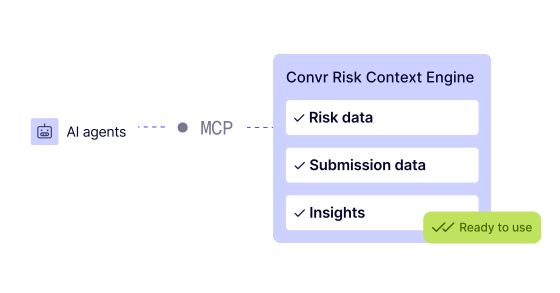
Calibrated on a decade of production data and more than 2,500 integrated sources, the RCE powers every AI capability across the Convr AI Underwriting Workbench from intake to business classification, risk scoring, data enrichment, and workflows.

Why this matters operationally to the CUO

The CUO's mandate is to make good risk decisions, consistently, at scale, in ways the organization can defend and document exactly with reliability. The RCE advances all these dimensions simultaneously.

Consistency: One of the most persistent sources of combined ratio deterioration is inconsistent appetite application . . . underwriters in different territories or teams making materially different decisions on similar risks. The RCE delivers consistent, traceable, verifiable risk data, in-line, which means the same exposure in the same class code is evaluated against the same criteria every time, regardless of which underwriter opens the file or which office processes the submission. The CUO sets the appetite rules; the RCE enforces them uniformly.

Defensibility: Every classification, appetite call, and risk-score output traces back through the ontology to the source submission documents, loss data, and underwriter decisions that informed it. The regulatory direction is reinforcing the value of the RCE. When a regulator, reinsurer, or internal audit function asks why a particular account was accepted or declined, the answer is not a probability score from a black box. It is a documented chain of reasoning tied to real data. In a regulatory environment that is increasingly scrutinizing AI-driven decisioning, audit-ready outputs are not a nice-to-have. They are becoming a condition of doing business.

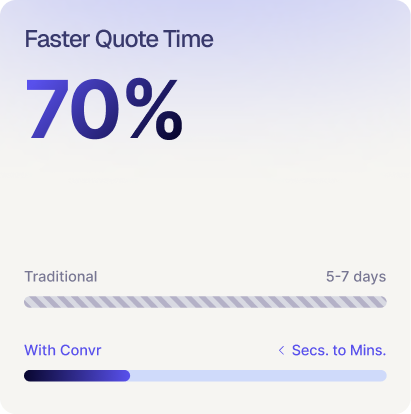
Scale: The RCE reduces submission-through-quote times by 70% and increases new business win rates. Carriers using the Convr AI Underwriting Workbench have documented an 8% combined ratio improvement on commercial auto lines, 20,000 submissions per month processed fully automatically on non-admitted lines, and 38% more quotes generated per underwriting assistant on financial lines, with quote generation time dropping from two hours to 20 minutes. These are not projections. They are outcomes from carriers already running the RCE in production.

The distinction that separates the RCE from everything else

As Convr Chief Executive Officer John Stammen stated at the RCE launch, "Everyone talks about models. The real question is what they're grounded in. Without a commercial P&C knowledge graph and ontology underneath them, generative and agentic AI are confident guessers. The RCE supplies the missing context . . . what a submission means, what an exposure is, what an underwriter decides . . . and turns outputs into decisions a carrier can defend."

That framing captures the CUO's core concern precisely. A CUO does not need AI that sounds right. They need AI that is right, and that can prove it. Convr unifies fragmented insurance data into a structured data model powered by ontology, schema, semantics, and a knowledge graph within the context engine . . . preserving risk relationships and enabling assistive AI to deliver decision-ready underwriting insights and trace those insights to any historical moment in time. The RCE is the infrastructure that transforms raw submission data, third-party enrichment, and historical loss experience into a single, coherent view of a risk, in real time, at the point of decision.

What this means for the CUO's book of business

For small commercial and BOP books, the RCE eliminates the premium leakage and adverse selection that accumulates when submissions are classified by hand. Business classification errors, misapplied territory codes, and underclassed risks . . . the chronic sources of ratio deterioration on high-volume books are caught at intake before they ever reach a rating engine.

For mid-market and multi-line accounts, the RCE compresses the enrichment cycle that consumes the most underwriter time. Rather than spending two to three days researching an account before rating, an underwriter opens the submission to find the business already classified, the exposure already verified, prior loss signals already surfaced, and appetite already scored against the carrier's own guidelines. The judgment call that makes underwriting valuable happens in minutes rather than days.

For large and complex accounts, the RCE provides the CUO with something that has historically been impossible to achieve at scale: a portfolio-level view of risk concentration, exposure accumulation, and appetite consistency across the entire book, updated continuously as new submissions are processed. The CUO who can see the book in real time, rather than waiting for a quarterly report is the CUO who can act on emerging trends before they become loss events.

The bottom line

The Convr Risk Context Engine is the foundational infrastructure that makes AI in commercial underwriting legitimate. It’s grounded in a decade of real production data, structured around the actual language and logic of commercial P&C insurance, and designed to produce outputs that underwriters, CUOs, and regulators can all defend. For the CUO who is already being asked by their board and their reinsurers how they are using AI, and who cannot afford the answer to be "we're experimenting," the RCE is the answer that closes the gap between AI's promise and underwriting's requirements.

News

Convr® Partners with Property Guardian to Bring Advanced Wildfire Intelligence Directly into the AI Underwriting Workbench

CHICAGO (June 16, 2026) – Convr®, the leading AI company serving commercial insurance organizations with its modular underwriting workbench, today announced a strategic partnership with Property Guardian, the wildfire risk analytics platform from Green Shield Holdings. Through the agreement, Property Guardian's property-level wildfire intelligence will be available directly within the Convr AI Underwriting Workbench, giving underwriters the data they need to confidently select, price, and monitor wildfire-exposed risks without interrupting their workflow.

Wildfires have become one of the most consequential and fastest-evolving perils in property insurance, reshaping appetite, capacity, and pricing across the western United States and beyond. Underwriters increasingly need transparent, defensible, property-level wildfire data to write business in exposed markets, rather than declining accounts or relying on generic regional risk scores. By integrating Property Guardian into Convr's workbench, customers gain a unified view of submission data, enriched business intelligence, and wildfire-specific risk insights, all in one place.

What the partnership delivers

Convr’s Property Guardian users can expect:

  • Property-level wildfire risk insights — including structure, parcel, community, and regional analytics — surfaced inline within Convr submissions
  • Access to Property Guardian's analytics, built on exclusive data partnerships with leading wildfire modeling and imagery providers
  • Faster, more defensible underwriting decisions in wildfire-exposed markets, with the ability to expand appetite into accounts that might otherwise have been declined for lack of clarity
  • Reduced reliance on costly in-person loss control inspections
  • A unified workflow that combines Convr's intake, enrichment, classification, and decisioning capabilities incorporating Property Guardian's specialized wildfire analytics
“Wildfire risk has fundamentally changed how property underwriters need to think about selection and pricing, and our customers have been clear that they want trusted wildfire intelligence available at the point of decision, not three tabs away," said John Stammen, Chief Executive Officer at Convr. "Property Guardian brings the depth of wildfire science, modeling, and expertise that complements the Convr AI Underwriting Workbench. Together, we're giving underwriters the clarity to write more business confidently in some of the most challenging markets in the country."

“Convr is transforming how commercial insurance organizations move from submission intake to underwriting decision, and this partnership brings Property Guardian’s wildfire intelligence directly into that workflow,” said Pat Blandford, Founder & CEO of Property Guardian. “Wildfire-exposed business does not have to be an automatic decline. With the right property-level data, underwriters can better understand risk, identify where mitigation and resilience matter, and make faster, more defensible decisions. Together with Convr, we’re helping carriers and MGAs bring greater clarity, consistency, and confidence to one of the industry’s most challenging perils.”

The integration is available to Convr customers immediately. Carriers and MGAs interested in learning more can visit convr.com or contact their Convr representative.

About Property Guardian

Property Guardian (part of Green Shield Holdings) delivers advanced wildfire analytics that help carriers, MGAs, and insurance professionals select, price, and mitigate risk in wildfire-exposed markets. By combining cutting-edge science with exclusive data partnerships, Property Guardian transforms thousands of wildfire signals into clear, actionable insights at the property level. Our intelligence supports smarter underwriting and portfolio management across the entire insurance lifecycle. Learn more at www.propertyguardian.com.

News

Convr® Unveils the Risk Context Engine, Grounding AI Underwriting in a Commercial P&C Knowledge Graph and Ontology

CHICAGO (June 9, 2026) – Convr® today unveiled the Convr Risk Context Engine (RCE), the industry's first knowledge graph and semantic ontology built specifically for commercial property and casualty (P&C) underwriting. Calibrated on a decade of production data and more than 2,500 integrated sources, the RCE powers every AI capability across the Convr AI Underwriting Workbench and gives carriers and MGAs the grounded, explainable foundation that agentic and generative AI alone cannot provide.

Carriers, MGAs and brokers are evaluating agentic agents, generative assistants, and large language models at an unprecedented pace. Most of these tools share a critical weakness: they are built on general-purpose foundation models with limited understanding of commercial insurance and not calibrated on real underwriting environments. The result is AI that can be inaccurate, inconsistent, irreplicable, and unexplainable. Underwriters, chief underwriting officers, and regulators cannot accept those qualities in risk decisioning.

The Convr RCE solves that problem. Built and refined since Convr's first founding, the RCE is a commercial P&C knowledge graph and semantic ontology that encodes the language, structures, exposures, classifications, and decision logic of underwriting into a unified, machine-readable model, calibrated against a decade of real submissions, real exposures, and real underwriter feedback from leading carriers in production. Every AI capability in the Convr workbench from intake to business classification, risk scoring, data enrichment, and workflows, runs on top of the RCE. The result is AI that doesn't just sound right. It is right, and can prove it: every classification, appetite call, and risk-score output traces back through the ontology to the source submission documents, loss data, and underwriter decisions that informed it.

The regulatory direction is reinforcing the value of RCE. The NAIC Model Bulletin on the Use of Artificial Intelligence Systems by Insurers, now adopted in some form by roughly half of US states, requires governance, transparency, and accountability for AI in regulated underwriting decisions, with parallel frameworks in New York, Colorado, and others. Those outcomes are not achievable on top of black-box inference; they require AI grounded in an inspectable knowledge graph and ontology of the underwriting domain. That is exactly what the RCE provides, with every decision traceable to the ontology and source data behind it.

"The industry is having the wrong conversation about AI in underwriting," said John Stammen, Chief Executive Officer of Convr. "Everyone talks about models. The real question is what they're grounded in. Without a commercial P&C knowledge graph and ontology underneath them, generative and agentic AI are confident guessers. The RCE supplies the missing context . . . what a submission means, what an exposure is, what an underwriter decides and turns outputs into decisions a carrier can defend. This is exactly what Convr has been building since 2016."

Availability
The RCE powers all Convr AI Underwriting Workbench deployments today. Carriers, MGAs and brokers interested in learning more can visit convr.com or contact a Convr representative.

Media Contact
Alex Williams
Senior Promotions Manager
alex.williams@convr.com
217-737-2782

Frequently Asked Questions

Find quick answers to common questions about our platform, capabilities, and implementation.

How does the underwriting workbench support end‑to‑end submission through quote and bind?

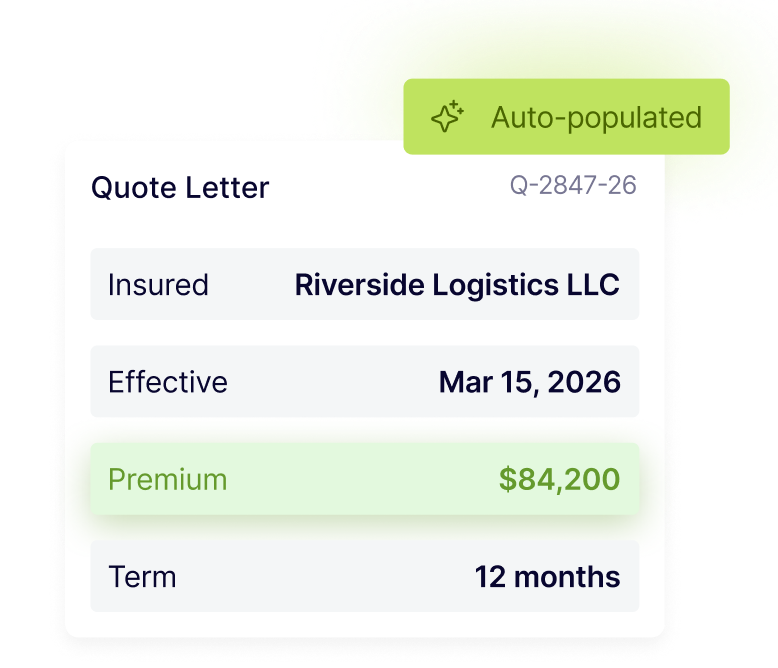
Convr provides a unified underwriting workbench that supports the full workflow from submission intake and clearance through underwriting analysis, rate, quote, bind, and renewal. The platform digitizes and enriches submissions, applies scoring and triage, supports rating and quote generation, and integrates with PAS for bind and issue—all within a single system.

How does Convr integrate with rating engines and pricing tools?

Convr supports multiple rating integration patterns, including API‑based raters and Excel‑based raters. Submission data is pre‑filled into raters, rating results are returned to the workbench for review, and quote versions are managed alongside underwriting documentation. This allows carriers to retain existing pricing tools while improving workflow efficiency.

How does AI support underwriting decisions in the workbench?

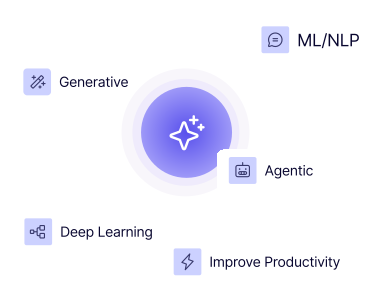
The Convr workbench uses AI‑driven extraction, enrichment, scoring, and prioritization to assist underwriters. AI models surface business classification, exposures, risk insights, and confidence scores while supporting straight‑through processing (STP) or human‑assisted review depending on carrier rules.

How is underwriting data structured, governed, and made explainable?

Convr organizes underwriting information using a commercial insurance ontology and knowledge graph, with all data persisted as a structured submission schema. The platform snapshots submissions at key lifecycle stages, enabling traceability, auditability, and advanced use cases such as material change detection and renewal analysis.