May 24, 2022
CASE STUDY
MMMM D, YYYY
xx min read

Convr’s Frictionless Underwriting Improves Employee Experience

Insurtech has become a powerful driver of change in the insurance industry and AI solutions for underwriting can drive competitive advantage.

How Convr’s AI is empowering and retaining the underwriting workforce

The future of work is no longer a far-off vision, it’s here and now. Insurtech has become a powerful driver of change in the insurance industry. With digital transformation revolutionizing the workplace, organizations need to adapt quickly to new ways of working to retain their top talent and achieve greater productivity, efficiency and profitability. Part of that revolution is in the insurtech space where artificial intelligence (AI) solutions are driving competitive advantage.\nIn the insurance industry, underwriting is a key space where AI can help improve workflow efficiencies. Underwriters are bogged down and burned-out by ever-increasing submission volume, tedious manual research and loads of data. The fatigue is real. They’re pressured between revenue and caution when making decisions. Their processes can be mundane, time-consuming, dated and loaded with setbacks. But Convr removes these burdens by simplifying and streamlining the intake process. Our frictionless underwriting automation solutions can be quickly and efficiently implemented and make an immediate difference for underwriters by reducing their manual processes, freeing them up to focus on decisioning and pricing – the art of underwriting.

Underwriters Need AI

There’s no better time than now to get underwriters the help they truly need. According to the Bureau of Labor Statistics Occupational Outlook Handbook, employment of insurance underwriters is projected to decline 2% by 2030. Despite lower numbers, about 8,300 openings for insurance underwriters are projected each year, on average. By equipping underwriters with advanced tools that help them operate more effectively, Convr is helping support a culture of underwriting excellence that values efficiencies and attracts and retains talent. And the next generation of underwriters is expecting this. They want to work with the modern technologies that allow them to work productively from anywhere using AI. The improved technology supports high-quality work and fosters a more positive relationship with the organization. Happy employees are productive employees.\nIn the coming years, the line between the real world and digital world will continue to blur. While consumer-oriented technologies continue to expand and people become accustomed to them, it’s time to take these developments into the commercial insurance underwriting environment. Convr AI is one way to easily improve your organization’s technology infrastructure and enhance the employee experience for underwriters.

blogs

Keep Reading

More articles on AI, underwriting and the future of commercial P&C.

XX MIN READ

The Hidden Cost of Manual Data Entry in Commercial Lines Underwriting

Ask a commercial lines insurance underwriting leader where their team's time goes, and the honest answer often isn't underwriting at all. It's data entry: keying in values from an SOV, cross-referencing a loss run against a submission, retyping limits and named insureds from a PDF into a rating system.

On paper, this looks like a minor operational cost, the price of doing business with documents that don't come in clean formats.  

The visible cost of manual data entry is time. A commercial property submission with a large SOV can take an underwriter or their support staff hours to process by hand, checking property values, occupancy types, and construction details against what's on the application. Multiply that across a full pipeline of submissions, and the hours add up fast.

While time is the cost that's easiest to see, it is often the least significant one. The hidden costs are the ones that don't show up until later.

‍The following are four hidden costs underwriting leaders need to consider:


Cost one: decision quality

Every hour an underwriter spends transcribing data is an hour not spent evaluating it. When manual entry eats into the day, the analysis that should happen around a submission -- spotting a concerning trend in loss history, questioning whether a stated property value is realistic, comparing an account against appetite -- gets compressed into whatever time is left.

Underwriting quality doesn't erode all at once. It erodes in small increments, submission by submission, as the ratio of time spent on data handling to time spent on judgment tips further out of balance. See why this is a hidden cost that cannot be overlooked?

Cost two: accuracy risk

Manual entry is also where errors creep in. A transposed limit, a missed COPE field, an incorrectly keyed TIV, these mistakes are easy to make and hard to catch, especially under volume pressure.

In commercial lines, where pricing and terms often hinge on the accuracy of property and exposure data, a small entry error can compound into a meaningfully mispriced risk. The cost of that error rarely surfaces immediately. It surfaces later, at claim time or renewal, when it's far more expensive to fix.

Cost three: inconsistent turnaround time

Manual processes don't scale evenly. When submission volume spikes, whether from a hard market, a new distribution partnership, or seasonal patterns, teams reliant on manual data entry hit a ceiling fast. Turnaround times stretch, brokers wait longer for quotes, and the accounts that move fastest aren't necessarily the best risks. In fact they're often the ones with the simplest paperwork. That's not a formula for disciplined underwriting; it's a formula for favoring ease over quality.  

Cost four: talent and turnover

There's also a cost that's harder to quantify but increasingly difficult to ignore: the toll manual entry takes on the people who are doing it.

Underwriters and underwriting assistants who spend a disproportionate share of their day on repetitive transcription rather than analysis tend to disengage from work that should be intellectually demanding. In a competitive labor market for underwriting talent, that's a retention risk hiding in plain sight.

Why this is solvable now

None of this is a new problem. What's changed is the availability of tools built specifically to solve it. Convr’s structured data ingestion, purpose-built for the ACORD forms, SOVs, and loss runs that make up commercial submissions, can take on the transcription work directly, pulling and validating data with a level of consistency manual entry can't match.

That data then feeds the Risk Context Engine, Convr’s ontology for commercial P&C risk, so a submission doesn’t sit as an orphaned record, it’s tied to the broader risk picture connected to prior submissions, relationships, and appetite history rather than evaluated on its own. That doesn't remove underwriters from the process. It removes the bottleneck standing between a submission arriving and a qualified underwriter evaluating it.

Rethinking where the real cost sits

The instinct to treat manual data entry as an operational cost is understandable.

It doesn't show up as a line item the way software or headcount does. But its true cost is distributed across decision quality, accuracy, turnaround times, and talent retention, all of which matter far more to a commercial lines book than the hours spent on submission entry alone.

The teams that recognize this are the ones rethinking where their underwriters' time really belongs, and building workflows that let judgment, not transcription, define how a submission gets handled.

If you’re ready for a conversation about re-envisioning how your team can improve the underwriting experience while avoiding some of these time sucking hidden costs, visit convr.com and book a demo today.


‍

XX MIN READ

Convr Prioritizes Communication in Underwriting Workbench

Email

Convr is making it easier than ever to communicate about submissions within the Convr AI Underwriting Workbench. Now there is an email capability where Convr customers can create new messages for submissions. A user would first need to have a specific submission open within the platform to see the email functionality available to them.

Within the left-hand pane they would just need to click, “Email” then “Create New Message.”

From there the “From” section will automatically be generated with their user email and they would need to plug in a recipient email address. The subject line would also be prepopulated with the submission name.

Convr users can also upload submissions assets and additional attachments about the submission in addition to crafting a customized message about the submission.

Comments
Within the Summary screen you can now also add a “Comment” about a submission, and they can be posted anywhere into Forms, Assets, Emails, etc. to support collaboration. Additionally, you can build a thread of comments. You can also reply to your own comment or react to another user’s comment with a thumbs up, as well.

The idea is that you’re creating a record or recorded conversation allowing another user to enter the platform, to get up to speed on the submission chat and join the conversation with the addition of new comments, which will show up within the feed as well.

You can tag users too, so they receive an in-app notification and email. You can also see in-app alerts, click on them and be taken directly to where you as a user were mentioned within the submission. This global, in-app notification feature is useful if a user wants to bring a team member’s attention to a given item within a submission.


The intent is to open lines of communication between underwriting team members to ensure there is greater transparency and oversight of submissions.

Convr is invested in improving the Convr AI Underwriting Workbench user interface for customers and believes these two new communication features will enhance collaboration and visibility throughout the submission process.  
 

To learn more about Emails and Comments capabilities reach out to Convr at convr.com to book a demo.

‍

XX MIN READ

Agentic AI Doesn’t Just Assist, It Acts

For most of its early history, the Artificial Intelligence (AI) that was used in commercial P&C insurance was a co-pilot. It was an always-on analyst sitting beside the underwriting team surfacing data, flagging anomalies, organizing submissions and more. It was genuinely valuable, yet it still relied on a human to make the call.

Agentic AI changes that equation entirely. It doesn't wait for a prompt or pass-back to a human for every decision. It perceives, reasons, decides, and acts autonomously, within defined parameters, at an unmatched speed and scale. With Agentic AI and the organizational shift from AI experimentation to real‑world execution, new challenges are emerging. If Agentic AI systems are making decisions and taking actions, insurance underwriting teams need to be ready. That means new roles and levels of authority need to be defined. That way, Agentic AI agents will operate within clear boundaries, stay anchored to trusted enterprise data, and scale confidently across the organization, so innovation accelerates without sacrificing governance and control.

The reason Agentic AI requires new operational control is specific to its potential independence of reasoning, decisioning and action. It’s collecting information and getting back to the underwriting team member(s) with a result or response. You're no longer just asking it a question, but giving it the autonomy to perform an action — giving it more authority to operate on your behalf.

When engaged via the Convr AI Underwriting Workbench, your organization benefits from the power of  this reasoning capability within an underwriting workflow. For example, it can act on your behalf sending emails back to a broker for more information. But better still, you benefit from the controls required to customize the workflows to your specific business and governance requirements.

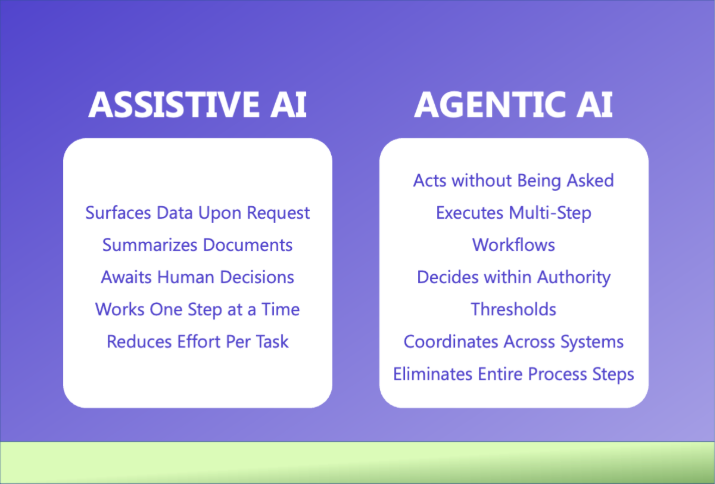
What separates Agentic AI from Assistive AI

Assistive AI is reactive. If you ask it a question, you’ll get an answer. If you feed it a commercial insurance underwriting submission, then you’ll get a summary. It’s powerful precisely because it reduces cognitive load — but the human remains in the loop at every decision point.

Agentic AI is proactive. It doesn't wait to be asked or given a prompt. Given a goal — clear a referral queue, flag a declination, prepare a financial analysis — an agentic system executes the full workflow: gathering relevant data, applying business logic, taking action, and reporting the outcome back to the underwriting team.

Here’s a helpful breakdown:


To learn more about Convr’s Agentic AI capabilities and what we’re doing for customers – get a demo now or read more about it on our newly revamped website at convr.com.


‍

Realize End-to-End Underwriting Excellence with Convr AI

Experience how commercial P&C insurance organizations benefit from submission through quote with a frictionless process enriched by AI decisioning, empowering them to make better decisions, faster.