March 24, 2026
CASE STUDY
MMMM D, YYYY
xx min read

Convr® Evolves Data Catalog for Faster, More Transparent Underwriting

Convr took a leap toward delivering the next big advancement in AI underwriting through the enhanced performance and usability improvements of its Data Catalog.

Convr®, took a leap toward delivering the next big advancement in artificial intelligence (AI) underwriting through the enhanced performance and usability improvements of its Data Catalog within its commercial insurance underwriting workbench in 2026. Convr’s Data Catalog makes it easier for underwriting team members to discover the thousands of data sources that are compiled in Convr’s Risk 360 data lake.\nThe leading artificial intelligence (AI) company serving commercial insurance organizations with its underwriting workbench implemented a new view for the company’s Data Catalog which aligns with its commitment to transform the commercial insurance underwriting industry and enables frictionless underwriting.\nWithin the model, users can easily glean insights from its extensive list of nearly 3,000 external data sources. Underwriters can also search across all Convr data sources, filter through the list by location, and view detailed information about each source with greater clarity. This new format allows users to quickly understand what data is available and how frequently it is refreshed.\nWhat it shows:The Data Catalog displays detailed information about each data source, including:

  • Source name
  • Data type
  • Source update frequency
  • Convr update frequency
  • State
  • Last updated date

The new table format makes it much faster and more intuitive for users to locate the data they need. The clickable links are up-to-date avenues that serve as a streamlined source to greater information and transparency into submission data. Our customers have much to gain from this new functionality.\nTogether, these advancements within the platform's user interface mark a pivotal moment, advancing the industry toward a more intelligent and trustworthy underwriting process built on accessible, high-quality data.

blogs

Keep Reading

More articles on AI, underwriting and the future of commercial P&C.

XX MIN READ

Convr® Knowledge Graph Unifies Commercial P&C Data in a New Modern Interactive View

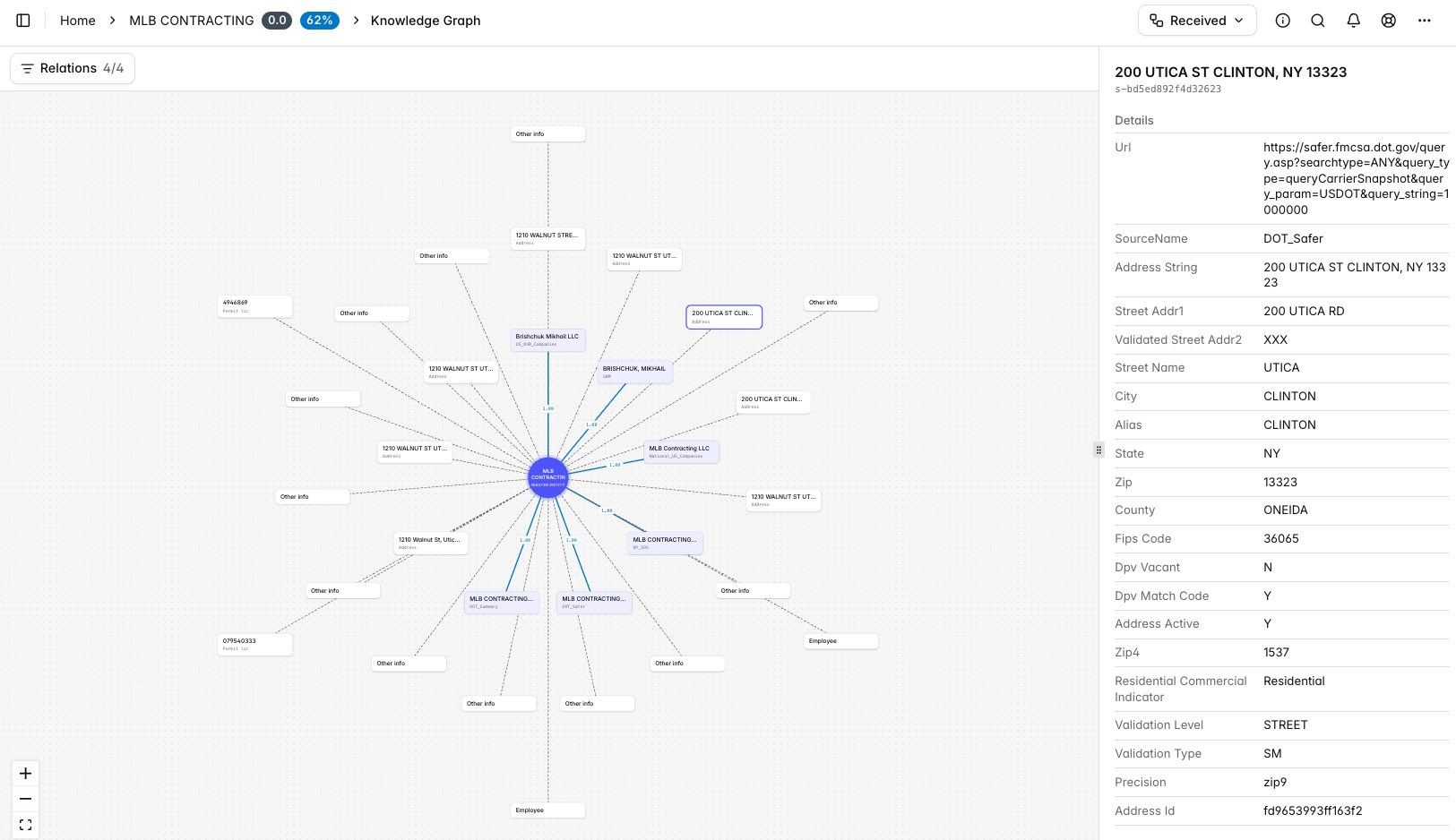
With auditability and governance top of mind, Convr® has designed a new graphical representation of the purpose-built P&C insurance ontology that powers its Risk Context Engine. The new visual map defines how classes of business, exposures, hazards, and risk attributes relate to one another, while tracing them to the source.

Rather than treating data as a flat list of fields within a table view format, the new knowledge graph gives Convr’s data meaning and context. In this way, Convr enables users to better interpret underwriting data, connecting a submission's raw data points into a coherent, consistent risk picture that's traceable and verifiable.
‍

"Our new knowledge graph details every data element of a submission as the gray matter of a brain -- a mental graphic that shows exactly how every piece connects," said Harish Neelamana, Founder, President and Chief Product Officer at Convr. "Most companies keep their data in a black box. We're doing the opposite, giving underwriters an inside lens into the data lineage so they can see exactly how every data point connects."
‍
“Convr's new knowledge graph improves usability, allowing users to see relationships and connections more clearly and explicitly interact with the data,” said John Stammen, Chief Executive Officer at Convr. “The update gives underwriters a transparent, visual window into a submission's entire data lineage, showing exactly how every element connects.”

‍
Where many platforms bury data relationships in the background, Convr's knowledge graph makes those connections visible and traceable, helping underwriters move through submissions faster, with a clearer picture of each risk to justify their decisions. The feature reflects Convr's total commitment to transparency and explainability in AI-native underwriting.

XX MIN READ

Convr at ITC Vegas 2026: A Recap of Insights, Innovation, and Connection

The intersection of insights and innovation... challenge and collaboration – that's what #teamconvr found this year at InsureTech Connect (ITC) Vegas 2026, held September 27 through October 1 at Mandalay Bay in Las Vegas, NV.

Like every year we attend the convention, it was busy, busy, and busy again, with demos, conversations, new agreements and presentations. If you walked the expo floor, you were sure to find Convr on both ends. Through it all, for Convr, this year's event sponsorship further confirmed our purpose and value in the commercial P&C insurance marketplace.  

Over the course of the event, Convr team members talked with hundreds of conference goers about the efficiencies and decisioning advancements our Convr AI Underwriting Workbench brings to commercial P&C carries, MGAs/MGUs, and brokers through the practical application of AI.

But if you missed us – with so many vendors and sessions competing for attention – we still want to give you a chance to get to know us and connect.

What we do

Convr is an AI underwriting workbench and data platform that digitizes and fuses submissions with the best available data sources to surface underwriting insights, business classification, and risk scores. At ITC Vegas, we met with some of the most tech-forward people in the industry, true professionals devoted to bettering the experience for insureds and the underwriting teams that help protect them.

That's exactly what Convr's AI Underwriting Workbench is built to do. Every day, our comprehensive workflow speeds the path from submission to quote by simplifying and expediting the underwriting process, improving the experience for both underwriters and their customers along the way. With the fast return on investment our platform delivers, ITC Vegas was the perfect stage for #teamconvr to share what we bring to the table.

We showed up in force. The Convr team took part in the Datos Insights Insurance Leaders' Summit panel on Tuesday, September 29, delivered a Mic Drop presentation on the Innovation and Solutions Stage on Wednesday, September 30, hosted private demos in #MR18, and welcomed a steady stream of visitors to our purple booth, #2618, on the main exhibit floor.

Thanks to everyone who stopped by. We're already looking forward to continuing the conversations, starting new ones, and seeing what the post-conference brings! Visit us here to meet with us or book a demo now.

‍

XX MIN READ

Build an Audit Trail Around Every AI-Assisted Decision

Explainability becomes much more valuable when it is preserved as part of the underwriting record.

For each material AI-assisted recommendation, carriers should be able to reconstruct:

  • What information was used
  • Which source documents supported it
  • Which underwriting rule or guideline applied
  • What recommendation was generated
  • Whether the underwriter accepted, changed or overrode it
  • When the decision was made

This creates an evidence trail that can support internal review, governance and audit.

It also gives underwriting leaders a clearer view of how AI is being used across the organization.

Track Rule and Guideline Changes Over Time

Underwriting guidelines change.

Authority levels move.

Appetite evolves.

Referral thresholds are updated.

An explainable system should preserve the version of the rule that applied when the decision was made.

Otherwise, a reviewer looking at the account months later may see a different rule from the one the underwriter actually used.

Versioning helps answer a simple but important question:

What did the system know and what rule was in force at that moment?

That level of traceability is essential when AI becomes embedded in real underwriting workflows.

Make Overrides Visible

Underwriters will sometimes disagree with an AI recommendation.

That is not a failure.

Commercial insurance is full of exceptions, nuance and context that may justify a different decision.

The important thing is to capture the override.

A governed workflow can record:

  • The original AI recommendation
  • The evidence behind it
  • The underwriter's final decision
  • The reason for the override

That creates useful feedback for underwriting leaders and helps identify where rules, data or workflows may need improvement.

It also reinforces the role of AI as decision support rather than an unchallengeable authority.

Explainability Supports Better AI Governance

As AI use expands, carriers need confidence that underwriting decisions remain controlled.

Explainability supports that by making it easier to review:

  • How data entered the workflow
  • Which rules were applied
  • Where human approval was required
  • When exceptions occurred
  • Which decisions were automated
  • Which decisions were escalated

This gives governance teams a clearer view of how AI operates in practice.

Instead of relying on broad claims that a model is accurate, the carrier can inspect how individual underwriting recommendations were produced.

Avoid Black-Box Automation

The biggest risk in AI-assisted underwriting is not simply that a model could be wrong.

It is that the organization cannot tell why it was wrong.

A black-box recommendation creates operational friction because underwriters either have to trust it or recreate the analysis manually.

A traceable recommendation creates a better path.

The underwriter can review the inputs, inspect the evidence, understand the rule and decide whether the recommendation makes sense.

That is what turns AI from an isolated tool into part of a governed underwriting process.

Frequently Asked Questions

What Is Explainable AI in Underwriting?

Explainable AI connects an underwriting recommendation to the data, source documents and rules that produced it, so the underwriter can understand and verify the decision.

Why Is Source Traceability Important?

It lets underwriters confirm where a risk attribute came from and inspect the original evidence rather than relying only on an AI-generated output.

Does Explainable AI Replace Human Judgment?

No. It gives underwriters better context and evidence so they can review, accept, modify or override a recommendation with confidence.

How Can Carriers Make AI Decisions Auditable?

They can preserve source lineage, structured risk data, applied rules, rule versions, recommendations, human overrides and final decisions as part of the underwriting record.

Why Do Insurance Ontologies and Knowledge Graphs Matter?

They give AI a structured understanding of insurance concepts and relationships, helping the system connect risk data in a way that is more consistent and easier to explain.

Make AI-Assisted Underwriting More Transparent With Convr

AI delivers the most value when underwriters can trust the path behind the recommendation.

Convr helps commercial P&C carriers turn fragmented submission information into structured, connected underwriting intelligence through an insurance-specific ontology, knowledge graph and standardized risk schema.

That foundation helps create AI-assisted workflows where risk attributes can be traced back to source documents, recommendations can be tied to underwriting rules, and underwriters remain in control of the final decision.

The result is not just faster underwriting.

It is underwriting that is more transparent, reviewable and governed.

Explore Convr to see how traceable, explainable underwriting intelligence can help your team adopt AI without sacrificing the evidence, context and control that commercial underwriting requires.

‍

Realize End-to-End Underwriting Excellence with Convr AI

Experience how commercial P&C insurance organizations benefit from submission through quote with a frictionless process enriched by AI decisioning, empowering them to make better decisions, faster.