
Risk 360

The commercial P&C data lake – comprised of the ​digital footprint of millions of businesses – powering every submission.

How Risk 360 Works

Enable More Efficient and Accurate Underwriting

Enrich submissions from thousands of private and public data sources. Risk 360 runs at intake, not as a separate manual step. Your speed to quote improves because the enrichment is part of the workflow, not a delay added to it.

How It Works

Enable More Efficient and Accurate Underwriting

Enrich submissions from thousands of private and public data sources.

Fills in the Gaps

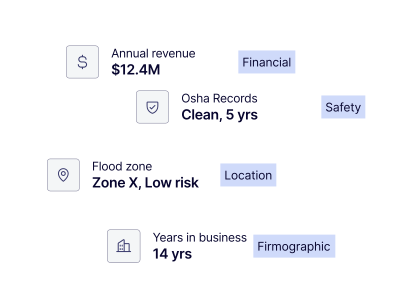
Submissions are enriched from the Risk 360’s data lake - firmographics, inspections, violations, licenses, permits, news, and social media - covering millions of commercial businesses.

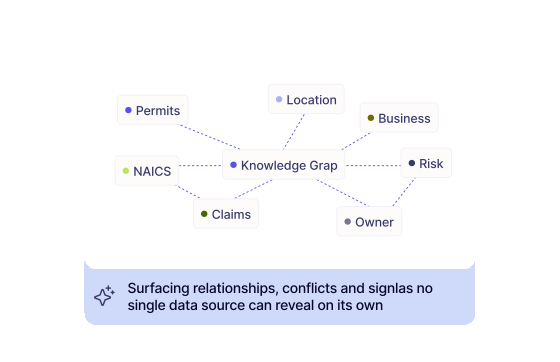
Validate Through the Knowledge Graph

Convr knowledge graph connects across thousands of data elements - surfacing relationships, conflicts, and signals - no single data source can reveal on its own.

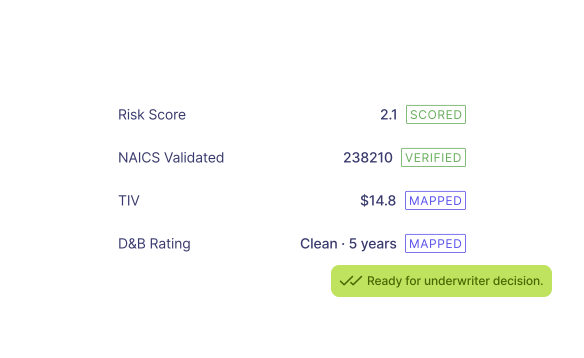
Deliver Structured, Scored Insights

Enriched data flows directly into the underwriting workbench - pre-scored, schema-mapped, and ready for the underwriter to act on. No external lookups, no separate logins, no manual reconciliation.

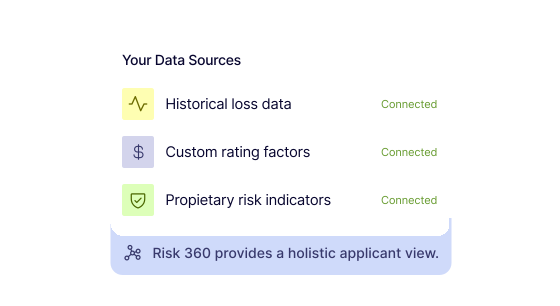
Bring Your Own Data

Risk 360 lets you bring it in - historical loss data, custom rating factors, proprietary risk indicators - and combine it with Convr’s enrichment in a single underwriting view to gain a more holistic applicant view and build more confidence in risk selection.

Enable More Efficient and Accurate Underwriting

Bring a real submission to your demo and we'll enrich it with Risk 360 Live.

Transform Your Business Today

Increase Efficiency by 130%

“With Convr, we now start reviewing most submissions the same day we receive it. We can do this without the need for quality checks on our end because we know Convr has taken care of it.”

VP of Underwriting · Tangram
The Convr AI Underwriting Workbench

Every Tool Your Underwriting Team Needs

Convr's modular workbench covers the full submission lifecycle from intake and enrichment to scoring, decisioning, and portfolio analysis, so underwriters work faster, smarter, and with more confidence at every step.

Scores

Know Which Risks Are

risk 360

A Complete Picture of
Every Risk

convr ai

Improve Productivity with  
Speed and Confidence

Resources

News and Insights

Insights, announcements, and trends shaping the commercial P&C insurance industry.

Blog

Convr Prioritizes Communication in Underwriting Workbench

Email

Convr is making it easier than ever to communicate about submissions within the Convr AI Underwriting Workbench. Now there is an email capability where Convr customers can create new messages for submissions. A user would first need to have a specific submission open within the platform to see the email functionality available to them.

Within the left-hand pane they would just need to click, “Email” then “Create New Message.”

From there the “From” section will automatically be generated with their user email and they would need to plug in a recipient email address. The subject line would also be prepopulated with the submission name.

Convr users can also upload submissions assets and additional attachments about the submission in addition to crafting a customized message about the submission.

Comments
Within the Summary screen you can now also add a “Comment” about a submission, and they can be posted anywhere into Forms, Assets, Emails, etc. to support collaboration. Additionally, you can build a thread of comments. You can also reply to your own comment or react to another user’s comment with a thumbs up, as well.

The idea is that you’re creating a record or recorded conversation allowing another user to enter the platform, to get up to speed on the submission chat and join the conversation with the addition of new comments, which will show up within the feed as well.

You can tag users too, so they receive an in-app notification and email. You can also see in-app alerts, click on them and be taken directly to where you as a user were mentioned within the submission. This global, in-app notification feature is useful if a user wants to bring a team member’s attention to a given item within a submission.


The intent is to open lines of communication between underwriting team members to ensure there is greater transparency and oversight of submissions.

Convr is invested in improving the Convr AI Underwriting Workbench user interface for customers and believes these two new communication features will enhance collaboration and visibility throughout the submission process.  
 

To learn more about Emails and Comments capabilities reach out to Convr at convr.com to book a demo.

News

Convr® Launches DocData, Propelling Submission Excellence and Intelligence for Carriers, MGAs, and Brokers

CHICAGO (September 8, 2026) – Convr®, the leading artificial intelligence company serving commercial insurance organizations, has introduced DocData for commercial brokers, carriers, and MGAs to submit their insurance application documents and receive a comprehensive risk summary for each submission in minutes.

DocData summarizes operational characteristics, exposures, loss history, and other essential data from original submission documents, providing organizations with a reliable overview that lets them know of the risk.

"Carriers,MGAs, and brokers share the same interest in perfecting application data whilereducing handling time,” said Harish Neelmana, Founder, President and ChiefProduct Officer at Convr. “Now they can feed submission documents to Convr and geta comprehensive review of the risk in just minutes.”

First-time users receive five submissions at nocost within five days. Users who see value in expanding to higher volumes can upgradeto the full Convr AI Underwriting Workbench with confidence in the returns theywill see.

Media Contact
Alex Williams
Senior Promotions Manager
alex.williams@convr.com

Blog

Agentic AI Doesn’t Just Assist, It Acts

For most of its early history, the Artificial Intelligence (AI) that was used in commercial P&C insurance was a co-pilot. It was an always-on analyst sitting beside the underwriting team surfacing data, flagging anomalies, organizing submissions and more. It was genuinely valuable, yet it still relied on a human to make the call.

Agentic AI changes that equation entirely. It doesn't wait for a prompt or pass-back to a human for every decision. It perceives, reasons, decides, and acts autonomously, within defined parameters, at an unmatched speed and scale. With Agentic AI and the organizational shift from AI experimentation to real‑world execution, new challenges are emerging. If Agentic AI systems are making decisions and taking actions, insurance underwriting teams need to be ready. That means new roles and levels of authority need to be defined. That way, Agentic AI agents will operate within clear boundaries, stay anchored to trusted enterprise data, and scale confidently across the organization, so innovation accelerates without sacrificing governance and control.

The reason Agentic AI requires new operational control is specific to its potential independence of reasoning, decisioning and action. It’s collecting information and getting back to the underwriting team member(s) with a result or response. You're no longer just asking it a question, but giving it the autonomy to perform an action — giving it more authority to operate on your behalf.

When engaged via the Convr AI Underwriting Workbench, your organization benefits from the power of  this reasoning capability within an underwriting workflow. For example, it can act on your behalf sending emails back to a broker for more information. But better still, you benefit from the controls required to customize the workflows to your specific business and governance requirements.

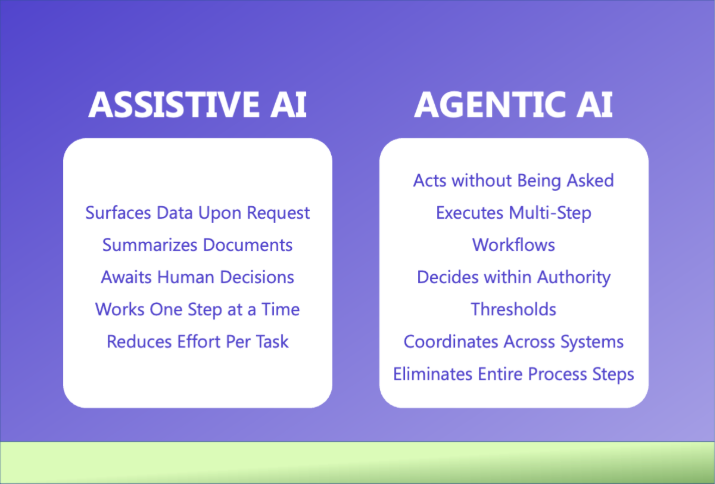
What separates Agentic AI from Assistive AI

Assistive AI is reactive. If you ask it a question, you’ll get an answer. If you feed it a commercial insurance underwriting submission, then you’ll get a summary. It’s powerful precisely because it reduces cognitive load — but the human remains in the loop at every decision point.

Agentic AI is proactive. It doesn't wait to be asked or given a prompt. Given a goal — clear a referral queue, flag a declination, prepare a financial analysis — an agentic system executes the full workflow: gathering relevant data, applying business logic, taking action, and reporting the outcome back to the underwriting team.

Here’s a helpful breakdown:


To learn more about Convr’s Agentic AI capabilities and what we’re doing for customers – get a demo now or read more about it on our newly revamped website at convr.com.


Frequently Asked Questions

Find quick answers to common questions about our platform, capabilities, and implementation.

What document types and intake channels does the Intake solution support?

Convr Intake AI supports ingestion of structured and unstructured insurance documents, including ACORD forms, broker emails, Statements of Values (SOV), loss runs, supplemental applications, and broker‑provided forms. Submissions can be received via UI, email, SFTP, or API, and are stored in a centralized digital document library for ongoing use across the underwriting lifecycle.

How does Intake use AI to extract, classify, and standardize submission data?

Convr Intake AI uses Intelligent Document Processing (IDP) with machine learning to split, classify, and extract data from incoming documents and normalize the results into a standardized submission schema, regardless of document format. Extraction confidence scoring is applied to assess input quality and guide review.

How does the platform handle low‑confidence extractions and human review?

The Intake workbench includes Human‑in‑the‑Loop (HITL) capabilities that allow underwriters or operations teams to review, validate, and correct extracted data in‑line. Feedback is captured to improve model performance over time while preserving audibility and workflow continuity.

How does Intake support clearance, triage, and prioritization of submissions?

Convr Intake supports clearance, duplication detection, fitness rules, and submission labeling. Submissions move through configurable workflow stages such as clearance, triage/prioritization, enrichment, loss analysis, and rating preparation, enabling faster routing and reduced manual effort.

How is intake data governed, stored, and made available downstream?

All extracted and enriched intake data is stored as part of a structured submission schema, persisted in Convr’s platform and made available via UI, Excel views, and open APIs. Intake outputs feed downstream underwriting, rating, quote, and bind workflows while supporting traceability, audit requirements, and integration with policy administration systems.

Explore Our Resources

Turn knowledge into action with resources built for smarter, faster underwriting.